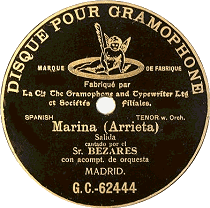
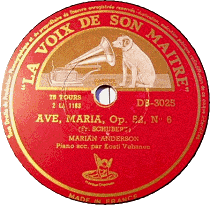
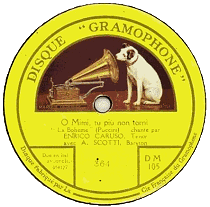
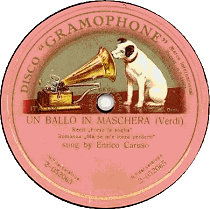
HMV Logos
(Back
To Vinyl Facts Menu)
When
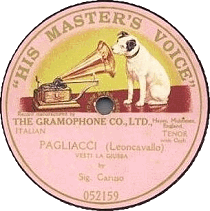
the HMV trademark first appeared on the label in February 1908,
the lower half of the label contained the same information that
had appeared on the Recording Angel labels. This included the company’s
identification below the trademark, the language and vocal range
or instrument, the selection, the artist(s)’s name(s), and the catalog
number. The font sizes varied, as can be seen in various Figures
IV.A.1.a. above.
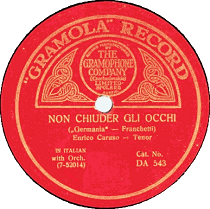
From February 1918
until September 1926, various company logos were printed between
two gold-lined quadrants placed at the lower left and lower right
(see under Double-Sided Issues below). The logos were retained
after the quadrants were removed in September 1926. Their use began
with the introduction of the "His Master’s Voice" trademark in February
1909, and continued until the end of the 78 rpm era, as well as
after the introduction of the double-sided DA and DB
series in August 1924, continuing with the DJ, DK, DL, DM, DO,
DQ, DR, and DS series by December of that year. These
series were used to designate artist and price categories, similar
to the use of different colors for single-sided issues. The DR
and DS series were reserved for Francesco Tamagno’s 10-
and 12-inch double-sided reissues, respectively.
The logos shown above
were used on single-sided discs between February 1918 and September
1926. Below are logos used on double-sided discs between October
1924 and September 1926.
The six logos below
were used after the removal of the quadrants in September 1926.
Apparently duplicate logos differ by their size and position.
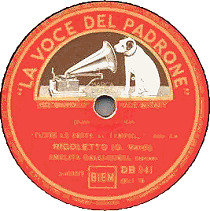
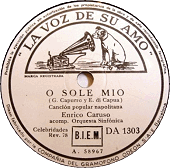
The
BIEM logo did not belong to the Gramophone Company, but rather to
an organization known as the Bureau International des Sociétés Gérant,
formed in 1929. BIEM is the international organization representing
mechanical rights societies, which exist in most countries. They
license the reproduction of songs, including musical, literary and
dramatic works. Their members are composers, authors and publishers
and their clients are record companies and other users of recorded
music. As a member of this organization, the Gramophone Company
and its successors were entitled to place its logo on their record
labels. When this logo or designation is found on HMV labels, one
can ascertain that the record was issued after 1929.
| |
|
| trademark
in black and white |
trademark
in sepia, 1939 - May 1946 |
| |
|
| |
|
| HIS
MASTER’S VOICE |
| after
August 1910 |
after
1929 |
Trademark Variations
| |
|
| IV.B.6.a.1 |
IV.B.6.a.2. |
| |
|
| IV.B.6.a.3. |
IV.b.6.a.4. |
| |
|
| |
IV.B.6.a.6).a). |
|
|
|
IV.B.6.a.7). |
Foreign Label HMV
Designations
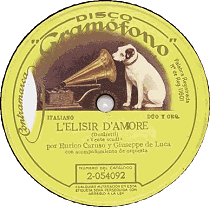
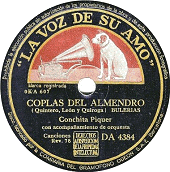
The
five labels above IV.B.6.a.8).
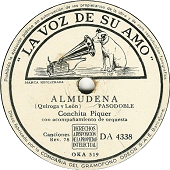
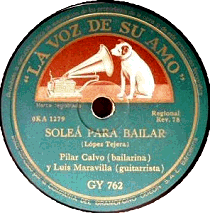
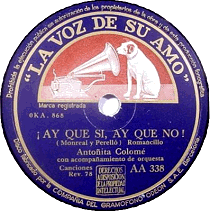
were used in the 1930’s for discs issued locally in Spain. The disc
on the top left is that of a re-recording made on August 15, 1932.
They were all manufactured in Barcelona.
The
"His Master’s Voice" trademark, also known as the DOG, Nipper, or
HMV trademark, appeared in the upper half of all labels of the Gramophone
Company, its sister companies, and their successors, from about
August 1910 until the end of the 78 rpm recording era, about 1950.