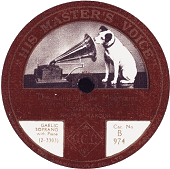
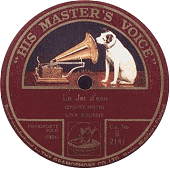
Double-Sided
Issues
(Back
To Vinyl Facts List)
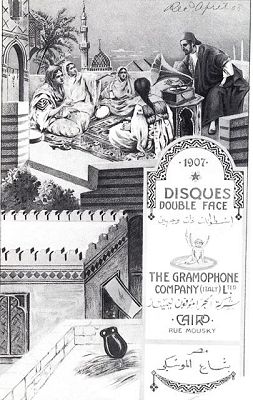
1907
Catalogue of Double-Sided Discs
The International Zonophone Company was among the first of several
record companies to introduce double-sided discs. Ademor N. Petit
in the United States appears to have held the first patent U.S.
No. 749,092, applied for on January 7, 1901 and granted on January
5, 1904. One-half of his patent interests were assigned to Frederick
M. Prescott, one of the founders and president of the International
Zonophone Company (see below). One of the earliest double-sided
discs was a coupling of the seven-inch discs Zonophone 376 and Zonophone
377, recorded in Berlin in October-November 1901. A large number
of both seven- and ten-inch recordings made in Brussels in early
1902 were also coupled. The first Milan seven-inch recordings to
be coupled were in September 1902, after which only a few seven-inch
recordings made in Paris in early 1903 are found in double-sided
discs. A considerable number of seven-inch recordings made in London,
Brussels, and Berlin are known as late as May and June of 1903.
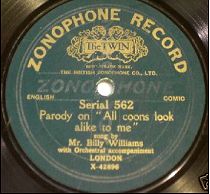
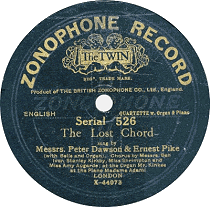
The
TWIN Record Company label, London, March 20, 1909
The first shipment of 646 ten-inch and 83 twelve-inch double-sided
records, presumably from the manufacturing plant in Berlin, was
made to Fred Figner or Casa Edison, Rio de Janeiro, Brazil, on May
15, 1902. These records consisted of blue label recordings made
in Europe, backed with orange label recordings probably made in
Rio de Janeiro. This would indicate that the stampers from the Brazilian
recordings had been shipped back to the Berlin plant. When the Gramophone
Company bought the International Zonophone Company in Europe, Ch.
& J. Ullmann of Paris had stocks of Zonophone machines as well
as of double-sided records from the Berlin factory. Further shipments
were discontinued after May 15, 1904.
| |
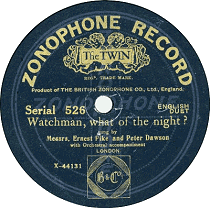 |
| London,
1907 |
London,
June 1909 |
Authorities differ as to when the Gramophone & Typewriter Ltd
issued its first double-sided discs. Alan Kelly states that double-sided
black and green label discs had been issued in both sizes as early
as 1906. John Bennett indicates that double-sided discs were issued
in September 1907. Frank Andrews, on the other hand, states that
the Gramophone Company, Ltd. introduced its first double-sided labeled
discs in August 1908. A secondary department of the company was
organised as The Twin Record Company, which launched "The Twin Double-Sided
Record." These records were only issued in the ten-inch size, and
sold for slightly more than single-sided records. During 1910 the
Twin Record Company merged with the British Zonophone Company, another
subsidiary of the Gramophone Company. The new company began issuing
only double-sided discs under the Zonophone label, and to issue
double-sided 12-inch discs in May 1911.
| |
|
| recorded
in Milan, November-December 1906 |
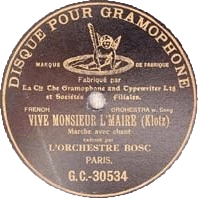
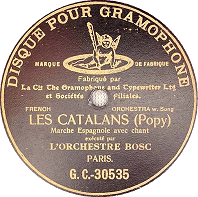
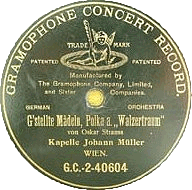
Labels on each side of double-sided records are not always of the
same size. Moreover, when the ring diameter was reduced from 88
to 80 mm, the size of the label remained at 90 mm. As the outer
ring diameter changed, the overall diameter of the label was also
reduced, leaving a margin of about 5 mm all around.
| |
|
| Recorded
in Paris, May 1906, issued before 19 November 1907 |
Double-sided discs are found with G&T labels for recordings
made before 18 November 1907, and with pre-DOG labels between that
date and February 1909. Early double-sided discs showed different
catalog numbers for each side, according to the original single-sided
number. No catalog number was provided for the double-sided disc
itself.
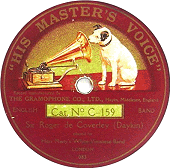
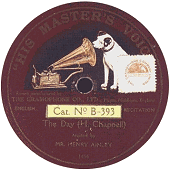
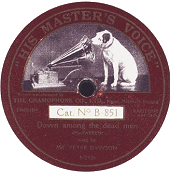
In September 1912 the Gramophone Company issues 102 twelve-inch
("C" series) and 55 ten-inch ("B" series) double-sided discs. All
were Band, Orchestral, or Instrumental recordings, and all bore
plum-colored labels. Bennett describes this color as violet red.
These series continued throughout the remainder of the 78 rpm recording
era, replacing the double-sided discs, which the Gramophone Company
had been issuing since May 1908 through their subsidiary, the Twin
Record Company. The changes and variations in the designs of the
labels are shown below under section V. Double Sided Issues.
| |
|
| Recorded
in Vienna, 1908, issued before February 1909 |
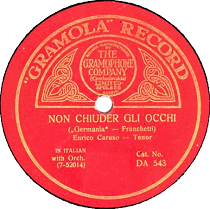
In February 1918 two new series were introduced, the 12-inch "D"
series and the 10-inch "E" series. These discs bore black labels
on both sides initially, but in March 1924, it was decided to reissue
all extant celebrity recordings from as far back as 1902, on two
new series of red label discs. These were the HMV DA and DB series.
Of the 20 original Caruso recordings of 1902, only 12 were reissued
in the first double-sided series. However, fourteen still appear
to be extant today, the other two being the "burnt up" shells identified
by Freestone and Drummond, which were re-recorded in his second
recording session of November 1902.
The recent compilation by Michael Smith lists 2,112 "D" series and
610 "E" series discs. HMV D1 was released in February 1918, and
E1 was released in July of that year. The last "D" series was issued
in November 1933, and the last "E" series was released in October
1930. In addition to the complete listings, this publication provides
cross references of disc numbers in manual, automatic, and duplicate
recordings for both series. A listing is also provided of all of
the discs recorded by each artist, as may be found in all of Bennett's
books.
Many double-sided discs in the "B", "C", "D", and "E" series were
reissues of previously or even concurrently issued single-sided
discs. The latter were issued as late as 1924. At the same time,
most "D" and "E" discs were issued only as double-sided discs. However,
the practice of assigning single-side numbers continued as late
as 1929. Smith states HO numbers, referring to Home Office,
as Ho. However, this is quite incorrect. The records themselves
indicate clearly that the HO form was always used.
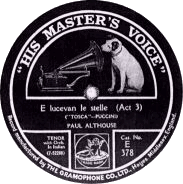
Further variations in the "DOG" or HMV labels deal mainly with the
presence or absence of quadrants, boxes, company logos, and different
colors in the lower half of the label. These are described under
Section VIII. The Double-Sided Issues. The following group
of figures shows most of the label varieties (from Andrews and Bayly).
| 
V.A1.a
|
V.A1.b.
|
V.A1.4.
|
| Sep
1912 – May 1913 |
Sep
1919 – Feb 1925 |
Sep
1926 – Oct 1932 |
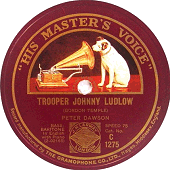
| 
V.A2.9.
|
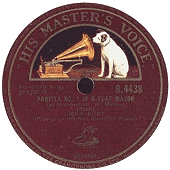
V.A2.12.
|
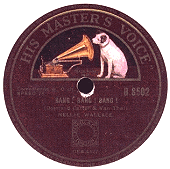
V.A2.13.
|
HMV
B and C Series Labels
From 1912 until at least the end of June 1924, single-disc numbers
were assigned to each side of most of the now double-sided discs,
although it is highly unlikely that those single-sided discs were
ever issued again. However, single-sided discs continued to be issued
throughout the remainder of the acoustical era. When these were
reissued on double-sided discs, as many of them were, the issuance
of the single-sided version was discontinued. Bennett lists many
of these sides under single-side numbers. The writer has checked
the original disc labels, or photographs thereof, of every acoustical
set from the 1917 Mikado through the 1936 electrical HMV
Mikado. Every side in every set has a single-side disc number
imprinted on the label at the left.
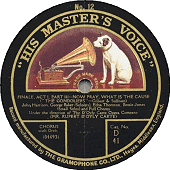
Left: HMV D 41, a 12-inch double-sided reissue of the single-sided
issues 04693 (shown) and 02830, recorded in June-July 1919.
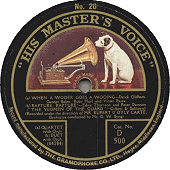
Center:
HMV D 500, a double-sided reissue of the single-sided issues
04283 and 04284, recorded in August and May 1920, respectively.
Right:
HMV D 1172, a 12-inch double-sided disc electrically recorded
September 26, 1926. Note speed shown at lower right.
The example of V.A.1.5. on the left below (see series above)
is HMV C 1023, recorded on April 20, 1921. It is unusual,
in that it shows no catalog numbers on either side of the disc.
The assigned single-disc numbers should have been 05667 and 05668.
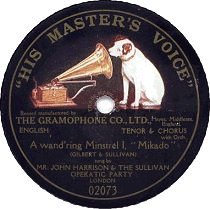
Among the earliest single-side reissues is John Harrison's "A Wand'ring
Minstrel I," from the 1906 Mikado recording on HMV 02073, shown
above. This was reissued on HMV D242, the second side being Harrison's
recording of "Thora," by S. Adams. The earliest single side listed
as reissued on HMV is Edvard Grieg's 1903 recording of his own "Au
Printemps," issued originally on G&T 35510 and reissued on HMV
D 803. The matrix number 2147F indicates that the recording was
made by Cleveland Walcutt in Paris on May 2, 1903. This is not to
be confused with matrix number 2147f, which Perkins et al. show
to have been used in 1907 in London.
The Celebrity series were first given DA and DB letters
in August 1924, together with all the old single-sided numbers.
The latter were shortly dropped from the catalogs. By December of
the same year, the DJ, DK, DM, DO, DQ, DR,
and DS series had been introduced, again for pricing purposes.
Moreover, these prefixes were also used to indicate that more than
a single artist appeared. At this time the principal celebrity label
color was red.
| |
|
| IV.b.3.b.
trademark 65 mm. diameter |
IV.B.3.d.
trademark 50 mm. diameter |
The
Opera Discs
When
World War I broke out on August 14, 1914, the German government
seized the Gramophone pressing plant in Hanover, together with over
600 Gramophone and Victor stampers and other parts in possession
of the Deutsche Grammophon Aktien-Gesellschaft (DGA). Many of these
stampers were used to press issued discs with labels such as those
shown below.
| |
|
|
Manufactured
by the Deutsche Grammophon
Aktiengesellschaft
Berlin-Hanover |
|
November 25, 1908 |
Berlin,
January 15, 1914 |
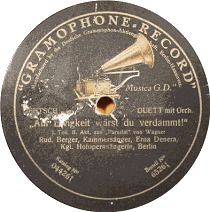
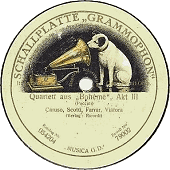
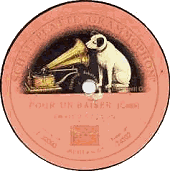
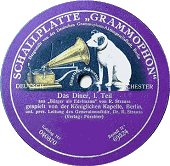
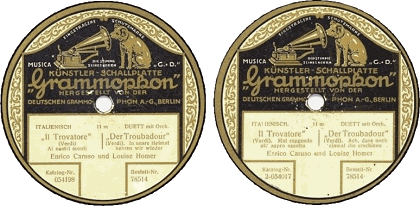
The figures above show early Schallplatte issues, both bearing the
phrase "Hergestellt von der Deutschen Grammophon Aktiengesellschaft,
Berlin-Hanover" above the modified HMV trademark. Later Schallplatte
discs, as seen below, show the phrase "Hergestellt von der Deutschen
Grammophon Aktiengesellschaft, Berlin" in an arc above the trademark,
indicating that most of these discs were manufactured in Berlin.
Later issues used labels with the complete HMV trademark, as shown
below.
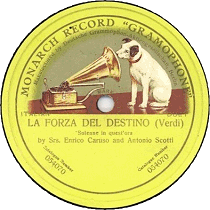
Manufactured
by the Deutsche Berlin, January 15, 1914
Grammophon
Aktiengesellschaft Berlin, Mar 13, 1906
Following World War I, when France and England were embroiled in
legal tangles regarding German war reparations, The Gramophone Company
of London was not permitted to use its own name in Germany nor to
sell records using the company’s trademark "His Master’s Voice,"
as these rights were considered to belong to the now independent
Deutsche Grammophon Gesellschaft. During the post-World War I period
DGG also issued its own pressings of the stampers in its possession.
These were single-sided discs bearing the Schallplatte „Grammophon"
or S.G. label seen above.
During this post-war period DGG issued its own pressings of the
stampers, single-sided records bearing the Schallplatte „Grammophon"
or S.G. label seen above, and double-sided issues with the lower
two styles of labels. These labels bore catalog numbers of both
the Gramophone Company and DGG.
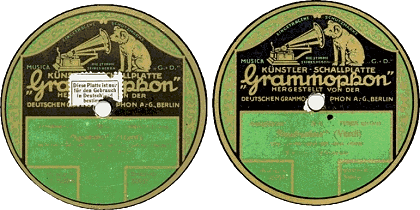
Double-sided issues under the Künstler Schallplatte, Grammophon"
(K.S.G.) labels are shown above. These labels bear catalog numbers
of both the Gramophone Company and DGG. The label style above was
used for twelve-inch issues, while that below was used for both
sizes. Both labels show engineer’s marking impressed upside down
through the label.
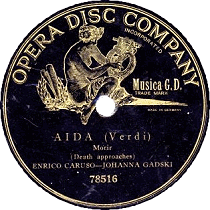
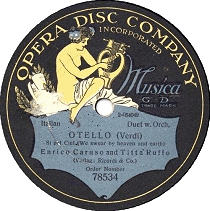
In March 1917, the German government auctioned off the various assets
of the Gramophone Company in Germany at the time. Officials of the
newly formed Deutsche Grammophon Gesellschaft (DGG), not to be confused
with the Deutsche Grammophon Aktien-Gesellschaft (DGA) formed by
William Barry Owen, licensed the stampers to their own newly formed
subsidiary, Polyphone. These were in turn licensed to a New York
firm, the Opera Disc Company. In 1920 the latter was soon flooding
the United States with quasi-legal but nevertheless excellent pressings
of these confiscated recordings.
| |
|
| |
|
|
The
so-called Opera Discs |
| |
|
|
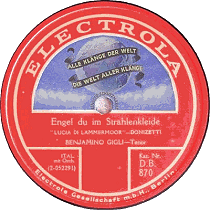
Recorded
in October 1917, Berlin |
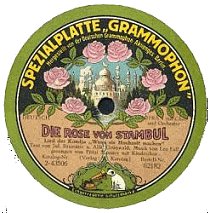
The very unusual label on the right above seems to have been issued
in honor or commemorate the opening night of Leopold Fall’s Operetta
Die Rose von Stamboul, which had its debut in Vienna on December
2, 1916.
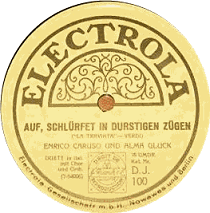
By 1922 it was decided to create two or more subsidiaries wholly
owned by the Gramophone Company of London. The German company, named
Electrola, was established in Berlin in 1925 and would compete
in Germany with DGG. A second company named Gramola was established
in Austria and the newly established country of Czechoslovakia,
with branch offices in Vienna and Prague, respectively. A pressing
plant was established in 1926 in Aussig, or Usti nad Leben, a small
town north of Prague, where Supraphon LP discs are still pressed
today. Neither company could issue DOG labels so new styles had
to be developed; and these consisted largely of geometric designs.
Records manufactured at the Aussig plant bore the phrase "Hergestellt
von der Oesterr. Grammophon-Gesellschaft m. b. H., Aussig a E."
above the trademark.
| |
|
| recorded
in Vienna
September 20, 1909 |
Die Stimmer seines Herrn
above spindle hole |
| Post-World
War I Pirate Issues |
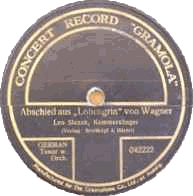
The label on the left above was printed in Aussig for a recording
made by Leo Slezak in Vienna on September 20, 1909. The original
HMV label was covered by the Gramola sticker to permit its sale
in Austria. Note the use of the word CONCERT in the arc,
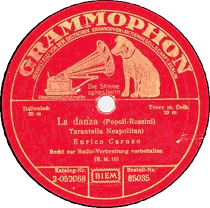
although the recording is a 12-inch one. The label on the right
is a 1912 recording by Caruso that was issued after 1929 by the
Deutsche Grammophon Gesellschaft (DGG), Berlin, with a later form
of the Künstler Schallplatte „Grammophon" label discussed above.
It has been said that the German companies never translated "His
Master’s Voice" into German. The label on the right above belies
this allegation, as one finds the phrase "Die Stimme seines Herrn"
above the spindle hole just inside the trademark itself.
| |
|
|
Recorded
April 20, 1914 |
recorded
1927 |
| |
| 1929
reissue of 1902 recording |
Victor
Talking Machine Company Labels
There seems to be no reason to present material here which has been
presented elsewhere in so excellent a format and coverage. The interested
reader is referred to the works of Michael Sherman, and of Allen
Sutton and Kurt Nauck, cited below in the Bibliography.