Celebrity Labels
(Back
To Vinyl Facts Menu)
The G&T Red label
was introduced in Russia, not only to distinguish the most celebrated
artists, but to command a high price for their issued records, usually
double the usual figure. These commanded the highest prices until
the recordings of Francesco Tamagno, Mattia Battistini, Nellie Melba,
and Adelina Patti, all of whom received special labels.
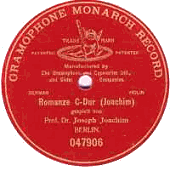
The disc on the
left below was recorded by the great nineteenth century violinist
Joseph Joachim on August 22, 1903 in Berlin. The matrix number 218y
shows an early use of this suffix by William Sinkler Darby. The
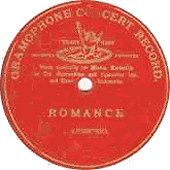
two records on the right below were issued privately for another
nineteenth century violinist Jan Kubelik. They were recorded on
October 26, 1902, the first and last of a group of five recordings
made on that date. They were issued privately without catalog numbers
and having matrix numbers of 2200 and 2204-W2,
respectively. Joachim was in his seventy-second year, while the
young Kubelik was only 22.
| |
|
|
| (photos
courtesy of Lawrence Holdridge) |
Francesco Tamagno’s
records carried labels showing the number of copies actually pressed
and assumed sold, so that he would be paid the proper royalties.
This policy was continued for the labels used by the Victor Company
on Tamagno’s records pressed and sold in the United States. The
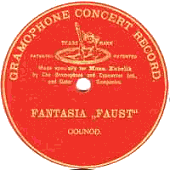
disc in the middle below was on of the first 12-inch recordings
issued by the Gramophone Company. The disc on the right is a most
unusual recording, having a piano introduction of 22 seconds, a
vocal portion of 44 seconds, and a final silent portion of 45 seconds.
The entire recording lasts less than 2 minutes, and could have fit
easily onto a ten-inch record. The disc on the right has the phrase
Manufactured by Deutsche Grammophon Aktien-Gesellschaft Berlin
under the Recording Angel, rather than the English version. This
was the name of the German branch of the Gramophone Company. The
date of manufacture is unknown, but was probably before August 1914,
since following World War I the company was reestablished independently
as the Deutsche Grammophon Gesellschaft (DGG).
Tamagno’s recordings
are unique in another respect, together with the recordings of three
other artists, viz., Caruso, Melba, and Patti. The latter two were
accorded labels, not only in colors of their choice but with their
signatures in facsimile, as well as the date of the recording. When
Victor issued their records, Melba’s were designated VICTOR "MELBA"
RECORD, on a lilac label with her signature in facsimile. Patti
received the usual Victor Red Seal label, designated as VICTOR
"PATTI" RECORD, but without the signature or the recording date.
| |
|
|
| |
|
|
| Francesco
Tamagno
G.C.-52674
Feb 7, 1903 |
Gramophone
Monarch
GM 052101
Feb 10, 1903 |
Manufactured
by
Deutsche Grammophon-
Aktien-Gesellschaft,
Berlin
|
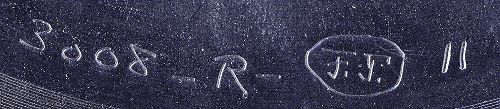
Tamagno
inscribed his initials within a circle following the matrix number
on those of the 32 ten-inch recordings that he made on February
7-11, 1903 of which he approved, but not on the 12-inch recordings.
His initials can also be seen on the Victor imported pressings made
from the G&T stampers.
The
ten recordings made by Enrico Caruso on April 11, 1902 all bear
his name in one spelling or another, viz., Caruso, Carouso, Caruoso,
Cauroso, or Carusso, inscribed in the central area to the right
of the spindle hole. Whether these writings were entered by either
Fred Gaisberg or his assistant at the time of these recordings,
or by various technicians at the Hanover plant, is moot. What is
most notable about the April 1902 recordings is that the information
inscribed in the central area of each of the ten wax recording tablets
appears, disappears, and reappears under the label, depending on
the position of the label, i.e., flush, raised, flush within a ring,
or sunken.
Of the estimated
twenty-two wax recording tablets which arrived at the Hanover plant
with the Weekly Return from Milan from April 6 to 11, 1902, two
would have been observed to bear identical matrix numbers, namely,
1782. It is highly likely that, not only did one or more
Hanover plant technicians decide to distinguish the two tablets
by adding the suffixes BG and nB,
to the Pinto and Caruso recording tablets, but another technician
made doubly (decimally?) sure that the ten discs from the singer
Caruso would be completely differentiated from the five recordings
made by Amelia Pinto. Hence the addition of Caruso’s name to all
ten tablets! The suffix nB has been conjectured to
mean neue Berliner, referring to the new all-wax recording
technique, although at this relatively late date following its first
use a year or so earlier is somewhat suspect. The meaning of BG
has never been determined, and occurs on three of Caruso’s first
G&T recordings.
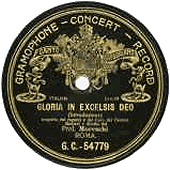
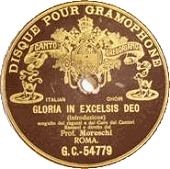
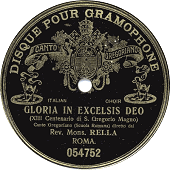
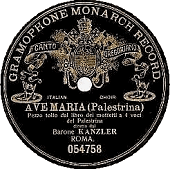
Many recordings
were made in Vatican City in the early days of the last century.
The first of these were supervised by Fred Gaisberg during the week
before the first Caruso recording session in Milan in April 1902.
The recordings were made chiefly of the choir of the Sistine Chapel.
The last and most notable (being the only one ever known to have
been recorded!) of the castrati, Alessandro Moreschi, and other
notable soloists.
The first issued
records bore black labels with gold lettering, and were distinguished
with a unique trademark in place of the usual Recording Angel, consisting
of the papal coat of arms to which was added two small Recording
Angels, on each side. Despite all his efforts, Fred Gaisberg was
never able to record the voice of the Pope Leo XIII. The labels
below show the Double Angel trademark with the papal coat of arms,
on two different disc sizes with German and French pressings from
April 1903.
Special
Labels
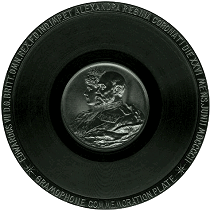
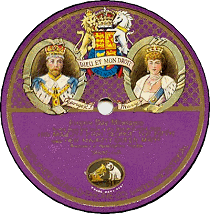
Perhaps the most
unusual labels issued by the Gramophone and Typewriter Limited are
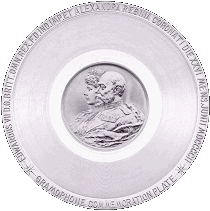
the following four memorial plates. The Gramophone Commemorative
Plate, issued in 1902 for the coronation of King Edward VII and
Queen Alexandra, is shown below. The leading rim of the Coronation
Commemorative Plate reads "EDWARD VII D.G. BRITT. OMN. REX. F.D.
IND. IMP. ET ALEXANDRA REGINA CORONATI DIE XXVI MENS JUNI MDCCCCII.
The reverse of this seven-inch record shows eight small Recording
Angel trademarks. All of these discs are actually Berliners, since
they have no paper labels. The top figures below are courtesy of
Kurt Nauck., and have been observed on several websites on the Internet.
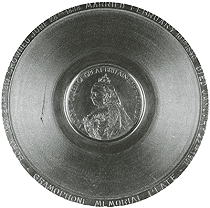
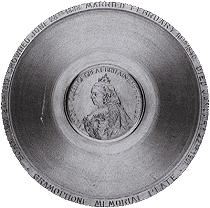
Similar issues were
made for Queen Victoria, Pope Leo XIII, and Kaiser Wilhelm II, as
shown below.
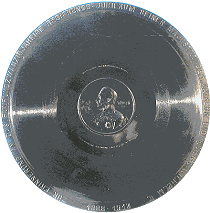
The
Queen Victoria disc reads "Born MAY 24TH, 1819_CROWNED
JUNE 28TH 1838_MARRIED FEBRUARY 10th 1840_DIED
JANUARY 22ND 1901 – GRAMOPHONE MEMORIAL PLATE –"
The illustrated record was issued to mark an occasion in British
history. Collectors will observe that the Berliner ‘plate’, issued
in between January and February 1901, has a finish far superior
to other discs contemporary of this time. This disc marked L 2 was
issued after the death of Queen Victoria, and is the normal size
of 7 inches. Unlike normal Berliners however, the thickness around
the rim is nearly ¼ inch. The recording is very clear and forward,
also luckily it has not been played very much, the recording, I
think, having a lot to do with the condition of the disc.
The
recording cut, in appearance, resembles the London cutter but it
may be more than a coincidence that the number prefix is L, this
may be one of the first discs pressed in England, as the time involved
must have been very short, as public mourning only lasted one month.
The recording is of Chopin’s Sonata in B flat minor, the third movement,
commonly known as the Funeral March. This is played by a brass band,
with muffled side drums, which are very well captured. Allowing
for the slow speed this disc is recorded at about 70 rpm. Comparing
other contemporary Berliners produced, with handwritten and etched
labels, the Trade mark Angel and Berliner Gramophone signs at this
time only being stamped, this Victoria disc stands out in finish.
All the lettering is stamped, the highlights of her reign being
given around the circumference. The centre area has an embossed
relief portrait, similar to the short lived one employed on British
currency in the 1880s
The reverse has a
polished surface with 8 angels set symmetrically positioned across
the area. The centre portion is enclosed with a raised ring in this
area is the Berliner Gramophone stamp and the record number. This
disc, lacking any centre spindle hole, came complete in a circular
cardboard box with an ebonised saucer shaped timber plate, the disc
fitting into the slight lip around the circumference. The saucer
is nearly 1 inch thick, which allows the spindle to be accommodated
in the thickness.
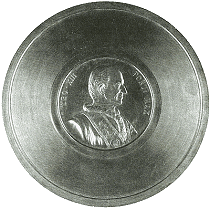
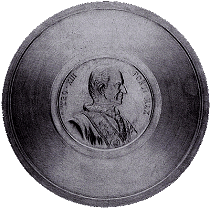
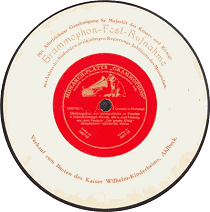
The
Pope Leo XIII Memorial Plate has no writing around the outer rim.
The inner rim says "LEO XIII and PONT. MAX". The pope
died on July 20 1903.
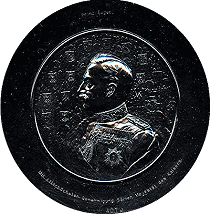
The inscription on
the commemorative disc for the 25th year of the reign
of Kaiser Wilhelm II reads ZUR ERINNERUNG AN DAS FUNF UND ZWANZIG
JÄHRIGE REGIERUNGS – JUBILÄUM SEINER MAJESTÄT DES KAISERS UND KÖNIGS
WILHELM II. 1888 – 1913. This translates to "In commemoration
of the twenty-fifth Jubilee year of the reign of His Majesty Kaiser
and King Wilhelm II 1888-1913." The image on the right shows the
central relief enlarged.
see
enlarged images
Two
Gramophone Company labels are shown above. Each label is 8 inches
in diameter, while the central label on the left is 4 inches in
diameter. The white label on the left is on the reverse of the commemorative
plate, and reads "Mit althöchster Genehmigung Sr. Majestät des Kaisers
und Königs aus Anlass des fünfundzwanzigjährigen Regierungs-Jubiläum
des Monarchen," which says in English: "With highest permission
of his Majesty, the Kaiser and King, GRAMMOPHON-JUBILEE-RECORDING,
on occasion of the twenty-fifth jubilee year of the reign of the
monarch," while the lower label say "Give to the best for the Kaiser
Wilhelm-Children-Camp, in Ahlbeck." The label on the right was placed
on the outside of the cardboard box, which c0ntained a metal base
covered with felt to support the 12" disc.
Since the Kaiser's
relief image occupies the center of the disc, there is no center
hole (unlike every other phonograph record ever made). Disc and
metal base had a concave bulge. Attached to the bottom center of
the inner box was also a green ribbon to lift the disc and
the original metal tray, enabling the record to be played on a normal
gramophone, victrola or even modern turntable. On the reverse side
is the red and gold label of the GRAMOPHONE COMPANY, in tradition
of their red label used for their Celebrity series started in 1902.
In the center is a small depression. These plates were intended
to be purchased by rich and aristocratic households. They
were only produced for German aristocracy by the German branch of
the Grammophon Company. Proceeds from the sale of these records
were intended to benefit a recovery and holiday camp in AHLBECK
for poor children from Berlin.
These
extremely rare records were produced in 1913 with 9 different recordings
in small, but very expensive editions. Three of the nine recordings
include the selection Carl Loewe: Prinz Eugen, der edle Ritter
– Prince Eugene, the noble Knight, sung by Paul Knüpfer (basso
with orchestra), recorded April 16, 1913, catalog number M 042399,
Das Herz am Rhein ("Es liegt
eine Krone) – The Heart of Rhein ("There lies a Crown"),
sung by Elisabeth Böhm van Endert on M 043226, and the Jubilee March
Heil, Kaiser, composed by Bruno Seidler-Winkler, and recorded
by the Gramophone Orchestra of Berlin under his direction on April
17, 1913, catalog number is 040747. A fourth recording was identified
in 1985 as 043227, recorded by Adelaide Andrejewa von Skilondz,
singing aria from an opera Il Re Pastore by Frederick the
Great of Prussia.
During the two World
Wars most of these records were broken. The very thick, but easy
breakable records were a symbol of aristocracy. The ending of aristocracy
and the beginning of other forms of government, wars, soldiers,
and poor people destroyed most of these records. Most of those seen
today have no dust case or green cover, and many have had spindle
holes drilled through the Kaiser’s image to accommodate a turntable.
| |
|
Empire Day
Message
Canadian Issue |
Special
label for Their Majesties’ Empire
Day Message, 1923 |
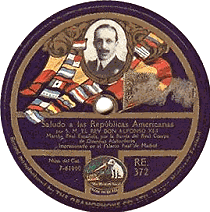
The
special label on the left below was designed for the recording of
King Alfonso XII of Spain’s address to the Spanish-American people,
made in Barcelona on December 16, 1924. The label on the right should
have borne the catalog number 41164, with a matrix number 1032x-B0’-2z.
It was recorded by William Sinkler Darby in Vienna on May 17, 1902,
but was not issued until after November 17, 1907. The reason for
its lack of a catalog number and its designation as a Special Gramophone
Record is not certain. However, it may have been due to the apparent
death of the performer on September 20, 1910, as indicated by cross
following the name.
In
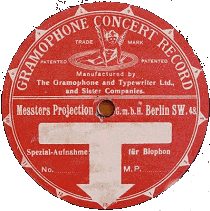
1903 A German named Oscar Messter invented a film process, called
Biophon, which integrated sound recorded on gramophone discs (see
above) with motion pictures. Although his films had little artistic
merit, he was able to present some 120 of the sound films at the
1904 World’s Fair in St. Louis. It would appear that the world was
not ready for sound moving pictures until 1927.
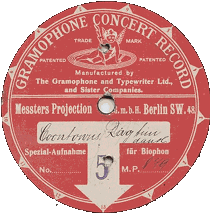
The
Messter Projection system, based in Berlin, was an early effort
to provide a musical sound track for silent films. Specially made
discs were co-ordinated with the projected images to add the proper
musical background. Like the later Vitaphone system in the USA,
it had limited success, as the problem of synchronization was always
difficult. If the film broke or had been repaired, or if the needle
on the record skipped a groove, it was almost impossible to regain
coordination between the record and the film. The discs for the
Messter system were pressed by Gramophone & Typewriter Ltd.