Scandinavian
Recordings and Labels
[Authors
note Scandinavia includes the three kingdoms of Denmark,
Norway and Sweden. The other Nordic countries, Finland,
Iceland and the Faroe Islands, are also sometimes included because
of their close historic and cultural relations to Norway, Sweden,
and Denmark.]
| 7-inch |
Stockholm,
March 1903 |
10-inch |
The
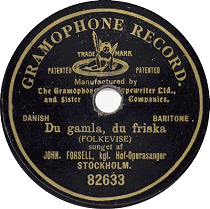
first recordings in Scandinavia were 119 7-inch discs in the A
suffix series made by William Sinkler Darby in Stockholm on December
3-4, 1899, followed by 96 more in Copenhagen in late December, 1899.
| |
|
| 7-inch
Stockholm, March 1903 |
7-inch
Copenhagen, April 1903 |
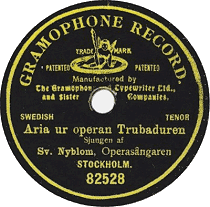
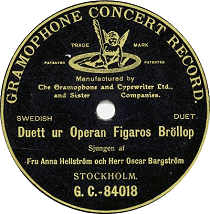
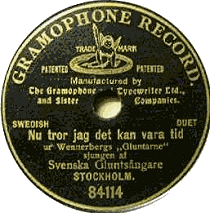
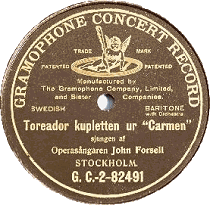
In March 1903 Franz Hampe made 82 seven-inch and 74 ten-inch recordings,
using C (later k) and z (later L) suffixes, respectively,
in Stockholm, and a further 81 seven-inch and 67 twelve-inch recordings
in Copenhagen in April 1903. On June 13 The Gramophone Company established
the Danish branch, Skandinavisk Grammophon AS, in Copenhagen, and
on September 28 the Swedish branch, Skandinavisk AB, was founded
in Stockholm. In Norway the Brødrene Johnsen Company was given the
sole agency for Skandinavisk Grammophon A/S in December 1904. One
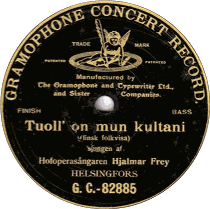
should note here that some of the latter recordings have labels
with Stockholm as the recording location, as seen in the figure
on the right above. Will Gaisberg made further recordings in Stockholm
in February 1904 and in Copenhagen at the Hotel National in March
1904.
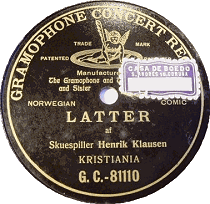
Will Gaisberg made the first gramophone recordings in Norway at
the Grand Hotel in Kristiania (now Oslo) on Thursday, December 8,
1904. The photography pioneer Adolf Østbye had the honour of being
the first gramophone artist, with his parody of "Terje Vigen". The
first recording sessions lasted until Saturday, December 10, and
among other participating artists were: accordionist Carl Mathiesen,
revue artists Agnes Haglund and Oscar Lerdahl, actor Henrik Klausen
(see below), opera singers Gabrielle Bidenkap, Nathalie Hansen,
Clara Hultgren, Halfdan Rode and Thorvald Lammers, plus the Guldberg
Quartet. Before this time several Norwegian artists had made recordings
other places than in Oslo. Edvard Grieg had made his piano recordings
in Paris in May 1903, while the opera singer Ellen Guldbranson in
Copenhagen and the singers Inga Berentz and Magna Lykseth-Skjerven
recorded in Stockholm in October 1904.
| |
|
| Kristiania,
December 1904 |
Pre-DOG,
Stockholm, 1907 |
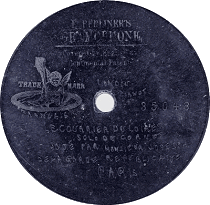
The disc shown below was recorded in St. Petersburg. Liliedahl lists
this recording with the matrix number 157zo, and places it
in 1901/2. Kelly lists it in his Old Zonophone Catalogue and in
the Russian Zonophone Catalogue, as having been recorded in 1904
in a zo matrix series of 360 recordings assigned to Franz
Hampe beginning in Berlin. In November 1904 Will Gaisberg made a
series of 42 7-inch, 52 10-inch, and 2 12-inch recordings in Helsinki
(then Helsingfors), following the series made in Copenhagen in March
1904. See also below under Zonophone Labels.
French
Recordings and Labels
The first French language discs were Berliners. The three discs
shown below were all recorded in Paris and processed in Hanover.
They all have REPRODUCED IN HANOVER on the reverse. The top
disc, Berliner 35048, matrix 3325, is from the unlettered
series, and was recorded in July 1899. All entries are sunk, indicating
that all were entered on the original zinc plate.
| |
|
| Berliner
35048, matrix 3325 |
The two discs shown below both show raised entries throughout. The
top disc, Berliner 30036, matrix 3644, was recorded by Fred
Gaisberg in Paris in August-September 1901. The lower disc, Berliner
30092 X, matrix 208F, was recorded in Paris by Cleveland
Walcutt.
| |
|
| Berliner
30036, matrix 3644 |
The Paris Office of the Gramophone Company, opened in May 1899,
had been responsible for the French market since June 1901 and for
the Spanish and Belgian markets since September 1905. Two new processing
plants were established, one in Ivry outside of Paris in 1907 and
one in Barcelona in 1908. Prior to the completion of the Ivry plant,
recordings from Spain (Barcelona and Madrid), Portugal (Lisbon),
and Belgium (Brussels) were processed at the Hanover plant.
| |
|
| Berliner
30092 X, matrix 208F |
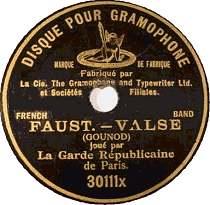
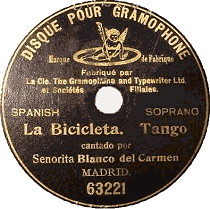
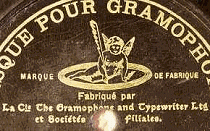
Labels printed for discs processed at the Ivry plant were designed
mainly for audiences who spoke French, Spanish, or Flemish. Thus,
both GRAMOPHONE RECORD and GRAMOPHONE CONCERT RECORD were
rendered as DISQUE POUR GRAMOPHONE, while GRAMOPHONE MONARCH
RECORD was retained for 12-inch issues. The words TRADE and
MARK became MARQUE and DE FABRIQUE, and the company
designation was modified to read La Cie, The Gramophone and Typewriter,
Ltd., Et Societés Filiales. Company designations included both
G&T and pre-DOG, and either the Recording Angel or the His Master’s
Voice trademark might be used. The pressing plant in Barcelona seems
to have become operational after February 1909, since no pre-DOG
pressings have been noted. The Barcelona plant remained under the
authority of the Paris branch until 1915.
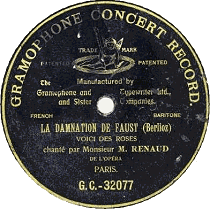
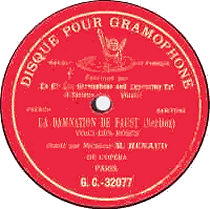
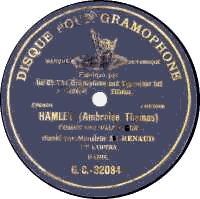
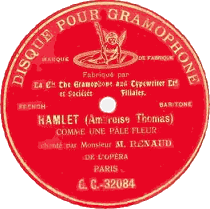
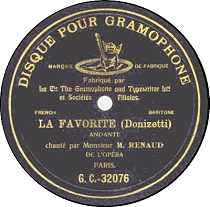
Recordings made by Fred Gaisberg in Paris in September 1901 of France’s
outstanding baritone, Maurice Renaud, were first issued with black
labels. Renaud was accorded Red Celebrity label status before a
secondary stamper became necessary, as shown above and below. In
the pair above, the disc on the left has a blank reverse, except
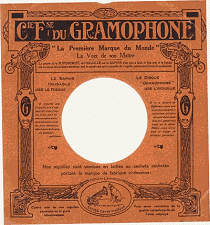
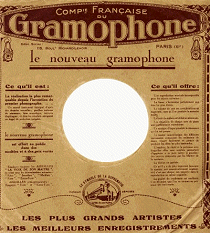
for the phrase REPRODUCED IN HANOVER. The two record sleeves
are typical of those used by the Companie Française Gramophone
at that time. All four discs have flush labels.
| |
|
| Paris,
September 1901 |
Paris,
November 1901 |
Both labels shown above are almost entirely in the French language.
Most notably, the words "PATENTED" were removed from the
trademark and replaced with "MARQUE" and "DE FABRIQUE,"
the French equivalent of "TRADE" and "MARK." The
four records shown above are first stamper pressings, and all have
flush labels 107 mm. in overall diameter. The Red Celebrity labels
were probably issued before May 1902, when the first records with
raised labels appeared. Occasionally the black labels with gold
lettering appeared in various shades of grey, as shown below.
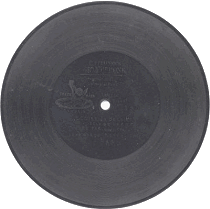
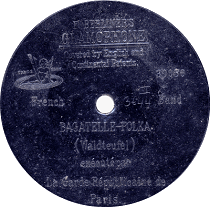
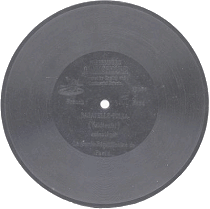
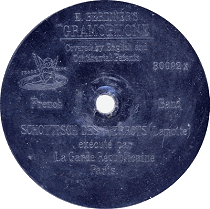
The
two labels shown below were for seven-inch discs recorded in Paris
and Madrid, respectively. That on the left is a retake recorded
in 1904, while that on the right, according to Kelly, was recorded
in Madrid in July or August 1902.
Early matrix numbers of recordings made in Paris and other locations
by the two assigned recording experts, Cleveland Walcott and Charles
Scheuplein, are somewhat confusing because the director of the Paris
branch, Alfred Clark, ignored the directives of the Gramophone Company’s
Head Office and decided that all recordings made under his authority,
regardless of size, should be assigned matrix numbers consecutively,
and all should have the suffix F, for the Compagnie Française.
In early 1902 Cleveland Walcott was given a block of matrix numbers
from 1F through 7000F, which he used mainly in Paris,
Antwerp, Brussels, and the Netherlands, while at about the same
time Charles Scheuplein began his allotted block with 7001F,
and recorded principally in Spain, Portugal, and North Africa. The
system started to fall apart when Walcott had recorded matrix 6999F,
which occurred in Brussels some time in 1906. By that time Theodore
Birnbaum, who was now the Managing Director of the entire company,
had overridden Clark’s directive and directed him to begin to use
the triplet letter suffixes n/o/p and t/u/v,
assigned to the Parisian recordists. Clark continued to use the
F suffix into 1908, when the triplet system finally prevailed.
By that time seven-inch recordings had ceased to be made, so that
Walcott retained only the suffixes o and p. Scheuplein
continued with the matrix number 202t, 9671u, and 0701v
for 7, 10, and 12-inch, recordings, with in Berlin, Vienna, Amsterdam,
and Scandinavia. (from Alan Kelly)
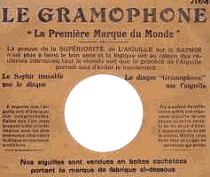
The
figure on the right above shows an original sleeve from 1903.