Later
Indian Recordings
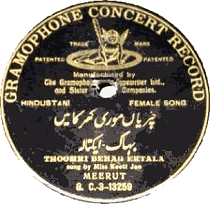
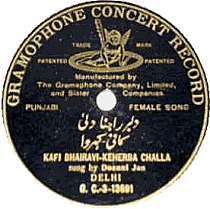
The disc on the left
above was recorded by Franz Hampe in 1905 in Meerut, a small town
about 40 miles northeast of Delhi. It was in the area surrounding
this town and Dehli that the Hindustani language developed. Alan
Kelly identified this recording, together with many others, as having
been made in Rangoon in Burma. The negative image on the right below
shows clearly that the record was processed in Calcutta.
Will Gaisberg left
London shortly after March 1906, accompanied by George Dillnutt,
and spent about seven months from May through November in India,
where he made 1,254 ten-inch and 148 twelve-inch recordings in Calcutta,
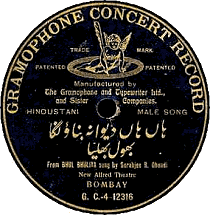
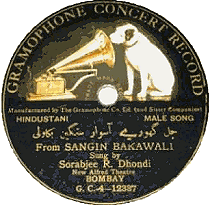
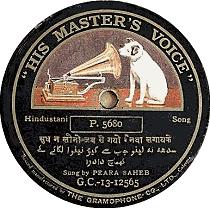
Lucknow, Hyderabad, Madras, Rangoon, and Delhi. Several labels used
for these recordings are shown below.
| |
|
|
Bombay
1906 |
| |
|
| Delhi
1906 |
Calcutta
1906 |
|
|
|
Lucknow
1906 |
| |
|
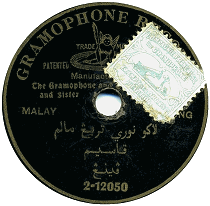
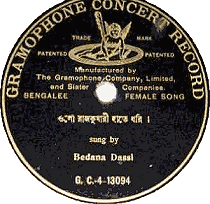
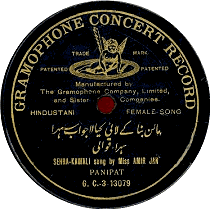
The recording date
and location of the disc on the left above is unknown, although
it was probably recorded between February 1903 and the end of November
1907. The disc on the right was recorded by George Dillnutt around
1920 and processed in Calcutta, with a matrix number 3464ak. The
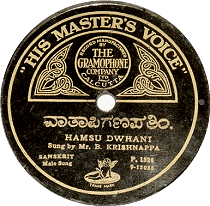
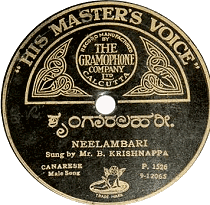
two discs shown below were recorded by Dillnutt in Mysore in August
1910, and were processed in Calcutta. The recordings are in Sanskrit
and Canarese, two of the 22 official languages of India.
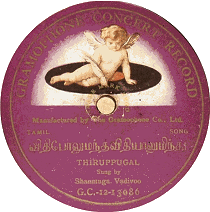
The disc on the left
below was recorded in July 1910 in the Madras presidency, and processed
in the Calcutta plant. India consists of 28 separate states, each
with an official language. Tamil, together with Sanskrit, Bengali,
and Hindi, is one of the oldest languages in the world, having developed
in the Tamil region of southern India and in Sri Lanka, formerly
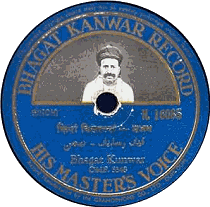
Ceylon. The recording on the right was undoubtedly manufactured
by the Gramophone Company in Calcutta after August 1910. Bhagat
Kanwar (1885 ─
1928) was a renowned Indian literary figure, and is regarded as
a saint in the Sindhi religion.
In
1909, the Gramophone Company of London sent Franz Hampe on an epic
5,000 mile journey across the southern regions of the Russian Empire.
From the Causasus Mountains to the deserts of Central Asia, he recorded
the various cultures and ethnic groups he encountered. What resulted
was an incredibly intimate view of pre-Soviet life, in the form
of almost 1,200 music recordings. Now, for the first time in over
90 years, a representative sample from the expedition can be heard,
from Caucasian male choirs to classical maqam singers from Bukhara
and the Ferghana Valley, and including several musicians who have
attained legendary status in the intervening decades, such as Jabbar
Karyagdy from Baku/Shushi and Mulla Tuichi Tashmuhammedov from Tashkent
From GEORGIA, ARMENIA, AZERBAIJAN, CHECHNYA and other culture groups
in the northern Caucasus, as well as AFGHANISTAN, KAZAKHSTAN, TAJIKISTAN,
UZBEKISTAN and XINJIANG in Central Asia, they were recorded at a
point when few of these names appeared on any map.
The following excerpts
from W. Prentice on the Internet Musigi Dunyasi website describe
in detail the route and activities of Franz Hampe during his six-month
sojourn. Items in brackets have been added by the author.
"Scattered
among the 10,000 or so 78rpm discs held by the International Music
Collection (IMC) were 46 ten-inch records, each recorded and released
before the First World War, some in the Caucasus and some in Russian
Turkestan (now known as Central Asia), by the Gramophone Company’s
regional office in Tiflis. The company began operations there in
1901, continuing after the war forced their departure in May 1918.
Each record stands as a tantalizing artifact in its own right, and
when considered together, they help construct a cultural picture
of the region during its final pre-Soviet years. As they were sold
originally in their "home" regions, it is not known how most of
them came to be in the IMC. We do know that ten were donated by
the daughter of Philips Price, an economist, traveler, and journalist
who based his 1912 book Siberia on his trip across the land, through
what is now Tuva, and into Mongolia. He accompanied Douglas Carruthers,
who went on to write the definitive early account of the region,
Unknown Mongolia (1913). It is quite likely that Price picked up
his records on this trip. With one exception from 1907, the remaining
36 discs all feature at least one side recorded in 1909, and none
were recorded later, suggesting that they were purchased within
a relatively narrow timespan, possibly by only one or two collectors.
"Thanks to the systematic
approach of the Gramophone Company, the matrix numbers stamped into
the runoff grooves on each side tell us in coded form, who recorded
the song, approximately when, and in what order. We know that one
of the sides was recorded by William Sinkler Darby in 1901 (the
year ten-inch records first appeared), three were recorded by Franz
Hampe from Berlin in 1903-4, thirteen by his brother Max in 1907,
75 by Franz Hampe in 1909 and two by the Englishman Edmund Pearse
in 1911.
"By
arranging the 765 recordings made in 1909 in chronological order,
the locations stated on the labels show us the route taken by Hampe,
starting in the northern Caucasus, then to Tiflis in Georgia, down
to Alexandropol in Armenia, through Azerbaijan and across the Caspian
Sea to Merv in Turkestan, heading east to the border with Chinese
Turkestan via Bukhara (then the capital of a nominally independent
emirate), Samrkand, Tashkent, and various other small towns. The
precise route through Turkestan was somewhat haphazard, until considered
on a contemporary map, where we can see that he was following the
only extant railway in the region.
"Having
arrived in Tiflis for the beginning of his expedition, Hampe faced
a round trip of over 3,000 miles with extremely delicate equipment,
through difficult and no doubt sometimes dangerous circumstances.
Tj Theobald Noble, who recorded for the Pathé Company in the same
region, described in a contemporary account traveling for eight
hours on horseback through the Caucasus to audition a single choir,
only to be ambushed and robbed by bandits on the return journey.
"Although towns
along the railway route through Turkestan were their main market
there, the company was keen to expand. A letter from Fred Tyler,
the manager in Tiflis, to the London Head Office in 1911, explains
that an employee was being sent to the more remote regions, taking
horses and donkeys loaded with gramophones and records. He was instructed
to travel from town to town, giving demonstrations and making sales
where possible.
"The labels on the
discs state the culture group to which each song belongs. From the
northern Caucasus fro example, the IMC holds recordings of Chechen,
Ingush, Kumyk, Kabardin and Ossetian music, as well as Georgian,
Armenian and Persian-Tartar (Azeri) recordings. All of the major
Central Asian cultural groups are represented, as well as musicians
from Afghanistan who were recorded in Merv [in May 1909], and from
Chinese Turkestan, recorded in Margelian [in August 1909].
"Hampe’s route in
1909 was typical of that taken by the other recordists, and he recorded
several musicians who had recorded before and would be again. Bagrat
Bagramov, a singer from Tiflis for example, had already proved himself
popular through records on previous trips, and so in [May] 1909
recorded 30 titles, significantly more than most other musicians.
Accompanied by two duduk players and known simply as Bagrat, he
recorded four instrumental, with himself playing hand-drum, and
26 songs; nine are sung in Armenian, seven in Georgian and ten are
Persian-Tartar. Tiflis was known as a particularly cosmopolitan
city at that time, and the collection bears this out. Armenian and
Georgian musicians were willing and able to play Armenian, Georgian
and Azeri music, as musicians such as Bagrat demonstrate. Azeri
musicians, on the other hand, such as the incredible singer Dzhabbar
Kariagdiev (DZHADBAR KARPIYAGDIEV in Kelly’s catalog), apparently
concentrated on Azeri music. Like Bagrat, Kariagdiev was obviously
highly regarded by the Gramophone Company, recording 25 titles in
May 1909, twelve of which had appeared on record by October of that
year, according to a contemporary catalogue. The IMC holds six recordings
of Bagrat and tow of Dzhabbar Kariagdiev. Altogether, Hampe recorded
60 hours’ worth of music in the region between April and September
of that year, over 55 hours of which were released on ten and twelve
inch 78rpm discs. Solo male vocalists with instrumental accompaniment
proved to be most popular in the Caucasus and Russian Turkestan,
followed by choirs in the former and vocal duets and trios in the
latter. The recordists were aware that the acoustic technology of
the time could pick up and reproduce strong voices more effectively
than it could most musical instruments, and so relatively few instrumental
titles were recorded. The relative lack of female vocal recordings,
at least in Turkestan, may be partly illuminated by the following
excerpt from Fred Tyler’s memoirs: To obtain women’s voices it is
sometimes necessary to make records in their own quarters, as, being
Mohammedans, they could not visit a public caravanserai with propriety.
In order, therefore, to avoid scandal, we sometimes packed all our
equipment on a cart and set out after dark to set up our studio
in the woman’s "house".
"From Bukhara, during
the 1911 recording trip, Edmund Pearse wrote home that ‘in Samarkand
we made some records of Harem women, a thing that has never been
done before. We had to take the machine to the house of the chief
magistrate and set up there, who thereupon brought forth the women,
and gave them permission to uncover themselves (only their faces,
however). It was quite romantic, especially as it all had to be
done after ten o’clock at night.’
"The Gramophone Company’s
motives for recording in the region were purely commercial. In recording
such a vast catalogue of indigenous music, their first thoughts
were of increased sales of gramophones it would encourage. Nonetheless,
in deliberately setting out to record a representative selection
of local music, they created what would later become an invaluable
resource for different cultures who, following the break-up of the
Soviet Union, feel a strong need to reconnect with their pre-Soviet
heritage.
"It is not known
how many of these discs have survived in their respective localities,
but it seems unlikely that many have. Over the past few years, researchers
from former Soviet territories, including Georgia and Adygea (Circassia)
have visited the NSA and the British Library, consulting the discs
and microfilmed documentation relating to the Gramophone Company.
Some of those musicians recorded have become national folk legends,
such as Magomet Khfgudzh, an Adygean accordionist recorded on several
trips, who, along with all the adult males in his village was shot
by the Russian army during the war of 1918. One recording of his
survives in the IMC (NSA Ref ICS0055110). His story and those of
a great many others are waiting to be researched and told, and there
has never been a better time to unearth them."
Hampe’s
route can be followed from the recording sessions listed in Kelly’s
catalogs. Starting in Vladikavkas (at one time Ordzhonikidze) in
April 1909, he proceeded to Tiflis in Georgia, Merv in what is now
Turkmenistan, Tashkent, Kokand, Skobelev, and Kashgar in Uzbekistan,
back to Tiflis in late August 1909 before proceeding to what was
probably Kutaisi in Georgia, and then returned to Moscow in early
October. These travels resulted in one 7-inch, some 1,062 10-inch,
and 31 12-inch discs.
| |
|
| Chinese
label |
Indian
label |
The first Persian
records were made in 1899 in London by Emile Berliner's Gramophone
Company, featuring poems of Hafez, Ferdowsi and Zahir e Faryabi
recited by an Indian called Dr. Ahmad) on 7" without paper label
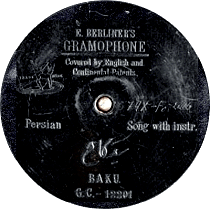
records. The disc on the left below is a 10-inch Berliner 12201
made in Baku on February 5, 1902. That on the right is a 7-inch
Berliner 22971 made in Tiflis (Russia) on February 15, 1902 by Emile
Berliner's Gramophone co as Persian or Persian Tartar.
| |
|
| Berliner
12201, February 5, 1902 |
Berliner
22971 February 15, 1902 |
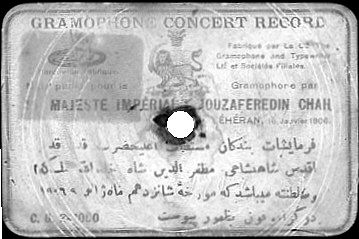
The
unusual label shown above recently came to the author’s attention.
It is listed in Kelly’s catalog as
SA MAJESTÉ IMPÉRIALE MOUZAFEREDIN CHAH
(His Imperial Majesty the Shah of Persia)
|
| 968 |
16-1-06 |
|
Speech |
|
(original spoilt) |
| 969 |
16-1-06 |
2-11002 |
do |
|
|
| 970 |
16-1-06 |
2-11000 |
do |
|
|
| 971 |
16-1-06 |
2-11001 |
do |
|
|
Max
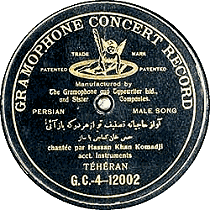
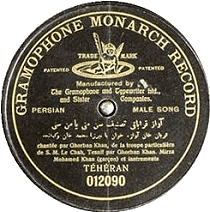
Hampe made the two discs shown below in Teheran, Persia in January
1906. These were from the first recording sessions, comprised of
148 10-inch discs and only eleven 12-inch discs. The disc on the
left below seems to have been recorded in 1908 and manufactured
in Calcutta. Although the label gives the language as Chinese, Alan
Kelly indicates that it is probably Bengali. The disc on the right
below was recorded in the Madras Presidency in July 1910.
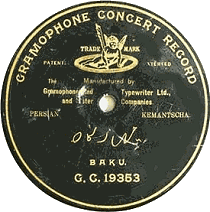
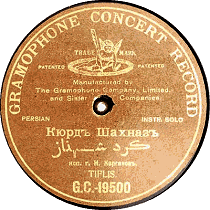
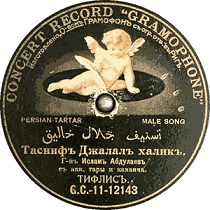
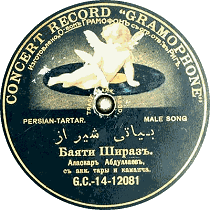
The
four discs below were recorded in Tiflis, the two on the top by
Franz Hampe in February 1902 and May 1909, respectively. Those on
the bottom were recorded by Edmond Pearse in late July, 1911. The
disc on the top right was recorded in Tiflis, despite the indication
of Baku. All Persian recordings were processed in the Riga plant.
| |
|
| February
13, 1902 |
|
| |
|
| Tiflis,
July, 1911 |
February
6, 1912 |
[Author’s
note: from the Wikipedia website ─ The kamancheh, kamānche,
kamāncha
or qyamancha
(Persian:  ,
Azeri: kamança), referred to on the top left label below,
is a Persian and Azeri instrument related to the violin. …This instrument
is widely played in classical Mugham music of Iran, Azerbaijan,
Uzbekistan and Turkmenistan, with slight variations in the structure
of the instrument. Kemenche is a Persian word derived from
the word keman(=bow, curve)" and suffix -che (gives "small"
meaning) means "little instrument played by bow". The same instrument
is called "kevançe" in Kurdish and "kemençe" in Turkish. The kamancheh
is the only bowed string instrument in classical Persian and Kurdish
music.
,
Azeri: kamança), referred to on the top left label below,
is a Persian and Azeri instrument related to the violin. …This instrument
is widely played in classical Mugham music of Iran, Azerbaijan,
Uzbekistan and Turkmenistan, with slight variations in the structure
of the instrument. Kemenche is a Persian word derived from
the word keman(=bow, curve)" and suffix -che (gives "small"
meaning) means "little instrument played by bow". The same instrument
is called "kevançe" in Kurdish and "kemençe" in Turkish. The kamancheh
is the only bowed string instrument in classical Persian and Kurdish
music.
In
central Asia many instruments can be the origin of kemenche. Studies
show that even there some different names like KIYAK and IKLIG the
name of instrument played by a bow is generally KEMENECHE among
the Mongol and Turk tribes in central and far Asia.
In Turkey, different instruments are called kemenche. The Blacksea
Kemenche and the Türkmen Kemenche (Southeastern Kemenche) are used
in folk music. The instrument used in Turkish Classical Music is
called as Classical Kemenche In some parts of Asia and Europe one
can see some instruments very similar to Turkish classical
kemenches with different names like LYRA in Greece, GADULGA in Bulgaria,
REBAB in some Arabic countries. On the other hand also you can find
similar instruments like Turkmen kemenche in Iran, Azerbaijan and
Armenia. ]