Elvis Presley
CD and Vinyl
United Western Recorders
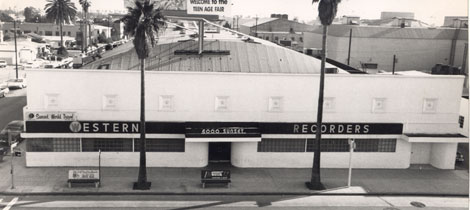
United Western Recorders was a two-building recording studio complex in Hollywood that was one of the most successful independent recording studios of the 1960s. The complex merged neighboring studios United Recording Corp. on 6050 Sunset Boulevard and Western Studio on 6000 Sunset Boulevard.
In 1984, United Western Recorders was renamed and succeeded by Ocean Way Recording. Starting in 1999, the complex was divided into two establishments: Ocean Way Recording (now United Recording Studios) at 6050 Sunset and Cello Studios (now EastWest Studios) at 6000 Sunset.
Some of the biggest hits of the 1960s were recorded at United Western. According to the book Temples of Sound, "No other studio has won more technical excellence awards, and no studio has garnered as many Best Engineered Grammys". Western's Studio 3 is considered iconic for its use by Brian Wilson for the Beach Boys' albums Pet Sounds (1966) and Smile (unreleased).
The complex's two buildings, United Recording and Western Studio, operated more or less independently despite being located only one block apart. United consisted of two large rooms; the larger United 'A' was approximately 45 x 65 x 22 feet, with United 'B' being slightly smaller. Western copied the layout of United, with the very large Western 1 and the somewhat smaller Western 2. Both buildings also had a third, smaller recording room, as well as several dubbing and mastering suites. The small rooms provided a sumptuous sound, with Western Studio 3, measuring just 34' x 15', being Brian Wilson's preference.
Prior to his move to California, Bill Putnam had founded the Universal Recording Corporation studio in Chicago. A pioneer of modern recording technique, Putnam became known for his UREI recording equipment and custom-made Universal Audio mixing consoles, which were bought by major recording studios. After relocating to Hollywood in 1957, and with the backing of Bing Crosby and Frank Sinatra, Putnam first established the United Recording Corp. studio complex at 6050 Sunset Boulevard in Hollywood. By 1958, Studio B was completed, including two reverb chambers. The facility grew to three recording studios, three mastering rooms, a mixdown room and a small-scale record manufacturing plant. The new studios were booked around the clock, busy with TV and movie voiceovers and soundtrack recordings as well as with popular artist's recordings. Hanna-Barbera used the studios to record voices for The Flintstones; Ricky Nelson recorded Poor Little Fool, the first-ever Billboard Hot 100 #1 song in 1958 along albums such a Rick Is 21 from 1961 which includes songs like Hello Mary Lou and Travelin' Man.
In 1961, Putnam purchased the neighboring Western Studio at 6000 Sunset, remodeling and incorporating the building into the complex. The buildings were then renamed United Western Recorders, and catered to some of the biggest artists of the era, including Frank Sinatra, the Beach Boys, and Elvis Presley.
Putnam assembled a talented staff, some of whom became major names in their own right, such as Bones Howe, John Haeny, Lee Hershberg, Chuck Britz, and Wally Heider, one of the pioneers of mobile recording and later of Wally Heider Studios. United was initially favored by older artists such as Crosby, Sinatra, Nat King Cole, and Ray Charles, as well as the young Fleetwoods, while Western soon became a favored recording venue for the new generation of pop-rock musicians and producers, such as Sam Cooke, the Beach Boys, Phil Spector and the Mamas & the Papas.
In the early sixties, Putnam scored a significant coup when major US record labels began to release stereophonic recordings in large numbers. According to Allen Sides, when stereo first appeared in the late 1950s, the cost-conscious major labels were initially uninterested, feeling that the market for the new format was limited, and that stereo mixdowns were a waste of time and money. Putnam however foresaw the coming importance of stereo and, at his own expense, he began making simultaneous mono and stereo mixdowns, storing away the stereo versions of these recordings, which at the time were released only in mono. When stereo took off in the early sixties, Putnam had amassed a stockpile of more than two-and-a-half years' worth of stereo recordings by scores of major acts. The value of this stockpile can be estimated from Sides' statement that United Western was at this time bringing in around US$200,000 per month in studio billings - equivalent to perhaps US$1 million per month today. The major labels approached Putnam hoping to buy the stereo tape stockpile, but he struck a far more lucrative deal, in which the labels repaid him for the (far more expensive) studio time he had used in making the stereo mixes.
In 1970, Jack Herschorn purchased the Universal Audio mixing console and other pro audio equipment from that studio, including Universal Audio LA-76A and LA-76B limiting amplifiers, Universal Audio vacuum tube power amplifiers (which were actually Dynakit Stereo 70 and 50-watt mono amplifier kits assembled into rack-mount chassis), Fairchild Conax sibilance controllers, Langevin graphic equalizers and Cinema Engineering filters, all originally installed in United Studio A in 1957. Herschorn had this equipment installed under the supervision of Charlie Richmond at Herschorn's Aragon Studios in Vancouver, Canada. The studio would later become Mushroom Studios.
In 1982, Eddie Van Halen purchased the UA console from Western Studio 2 and installed it in his personal 5150 Studio. The Van Halen albums 1984, 5150, and OU812 were recorded using the console.
In 1984, Putnam sold the studio complex to Allen Sides, who renamed the buildings Ocean Way Recording, as they would both be known until 1999.
In 1999, Sides sold the Western half of the complex to computer magnate Rick Adams, who renamed it Cello Studios. Cello Studios operated at the 6000 Sunset complex from 1999 to 2005. During that period, the studios hosted high-profile rock artists such as Blink-182, Rage Against the Machine, Tool, System of a Down, Weezer, Muse, Red Hot Chili Peppers, Audioslave, and the Mars Volta. Cello Studios closed in 2005.
When Allen Sides sold Western to Rick Adams, the equipment inventory was also purchased from Ocean Way Recording, including a collection of rare vintage microphones, as well as vintage outboard gear including valuable studio effects units such as the Fairchild 670 limiters, no longer made, which were a crucial element of the sound of many classic pop recordings of the Fifties and Sixties. While the building was modified to accommodate the new facility's needs, the studios themselves have not been altered since Putnam's original design. During this period, the studio played host to artists such as Alanis Morissette, Natalie Merchant, Elton John, R.E.M., Bette Midler, Barenaked Ladies, Stone Temple Pilots, Matthew Sweet, Motley Crue, Green Day, Vonray and Blink-182
At the beginning of 2006, Cello Studios (originally Western) was purchased by EastWest producer Doug Rogers and renamed EastWest Studios. Rogers extensively remodeled the non-technical areas of the studio complex with designer Philippe Starck, but the studios themselves, with their untouched acoustics, remain as originally built by Putnam in the 1960s and continue to operate to this day. Since 2012 EastWest Studios has racked up 130 Grammy nominations, more than any other recording studio in the world.
In 2013, Ocean Way Recording was sold to Hudson Pacific Properties, and in 2015 it was renamed back to United Recording Studios.
---------------------------------------------------------------------------------------------------------------------------------
The Burbank Studios (formerly known as NBC Studios) is a television production facility located in Burbank, California, United States. The studio is home to Days of Our Lives, Extra, the IHeartRadio Theater, and was formerly home to the Blizzard Arena (home of the Overwatch League).
NBC Radio City Hollywood, located at Sunset Boulevard and Vine Street in Hollywood, opened in 1938 and served as headquarters to the NBC Radio Networks' West Coast operations. It served as a replacement for NBC Radio City San Francisco, which had been in service since 1942. Since NBC never owned a radio station in Los Angeles, the network's West Coast programming originated from its San Francisco station (KPO, which later became KNBC, and is now KNBR). NBC radio network programming was carried on KFI in Los Angeles.
The architect for the distinctive Streamline Moderne building at Sunset and Vine was John C. Austin.
In January 1949, NBC launched its newest television station for Los Angeles, KNBH (Channel 4; now KNBC) from Radio City; the radio studios were later equipped for live television broadcasting in the transition phase from radio broadcasting. However, as television production was increasing for NBC, the network and its then-parent the Radio Corporation of America, decided to build a television studio, nicknamed NBC Color City, that would be exclusively equipped for color television broadcasting. For many of the same reasons why CBS eventually built Television City in the early 1950s to replace its Columbia Square, the television facilities at Radio City gradually became too small for NBC to produce its television broadcasts.
RCA's decision to expand television studio facilities required moving to the real estate market in the San Fernando Valley-Burbank area, with land purchased from Jack Warner. The newly-christened NBC Color City Studios opened in March 1955, as the first television studio designed specially for the origination of color television broadcasting, although their rivals, ABC and CBS would gradually add color broadcasting to their studio facilities in later years.
KNBC moved to a new building in 1962. In 1964, the Radio City Hollywood building was demolished, as NBC moved more of their West Coast television operations to the Burbank facility. The site is now occupied by a bank.
This studio hosted production of many of the best-remembered game and variety shows from the 1950s through the 1990s, including Hollywood Squares from 1966 to 1980, Wheel of Fortune from 1975 to 1989, Rowan and Martin's Laugh-in from 1968 to 1973, and The Tonight Show beginning in 1972. The latter two shows would frequently reference their home in "Beautiful Downtown Burbank" though Tonight would invariably begin each episode with the technically incorrect announcement, "From Hollywood..." During the late 1960s, Carson's Tonight Show would move for periods to Burbank, using studio 1. After the permanent move to Burbank in 1972, Bob Hope's shows taped in studio 1, with The Tonight Show taking a hiatus while Hope produced his specials. In 1971, President Richard Nixon announced Henry Kissinger's secret negotiations with Zhou Enlai and his impending visit to China from the studio.
The Tonight Show would stay in Burbank through Johnny Carson's retirement, Jay Leno's ascendency to host until the end of his first run in 2009, when it moved to an all-digital studio on the Universal lot in 2009 for the short-lived The Tonight Show with Conan O'Brien. The show moved back to the Burbank Studios when Leno returned as host of The Tonight Show on March 1, 2010. The show used studio 11 until Leno stepped down as host on February 6, 2014. After that, The Tonight Show moved back to New York City's Rockefeller Center when Jimmy Fallon replaced Leno as host, marking the end of the 42-year era in which the show had recorded in Southern California.
In October 2007, NBC announced plans to move most of its operations from Burbank to a new complex across the street from Universal Studios in Universal City. It would retain offices at the Burbank site until May 2013, though the studio complex was sold to Catalina/Worthe Real Estate Group in 2008, with NBCUniversal leasing space until 2013. The former Technicolor building on the Universal lot now serves as the home of NBC's West Coast operations. KNBC-TV and NBC News' Los Angeles bureau, along with Telemundo station KVEA, began broadcasting from Universal Studios on February 2, 2014.
The Burbank facility was one of the few television-specific studio facilities in Hollywood that offered tours to the general public until they ceased July 6, 2012.
On March 13, 2014, Lawrence O'Donnell announced that his MSNBC broadcast that night would be the last nationally-televised program to be broadcast live from NBC's Burbank studio, with the move of the NBC News Los Angeles bureau to Universal City.
On October 2, 2017, Studio 1 became the official home of Blizzard Arena Los Angeles and the Overwatch League, marking the Burbank Studios' first esports broadcast. The inaugural season began on January 10, 2018, in which over 437,000 viewers tuned in live on opening night via Twitch and MLG.tv streaming platforms. The final match was played on September 15, 2019, before the league moved to a traditional sports home-and-away format.
On April 15, 2019, WarnerMedia (now Warner Bros. Discovery) announced that it would purchase The Burbank Studios. The transaction was completed in late 2023.
On July 15, 2024, it was announced that Worthe Real Estate Group, QuadReal Property Group and Stockbridge Capital Group would reacquire The Burbank Studios as part of a years-long deal with Warner Bros. Discovery. The three companies paid $375 million for the 27-acre film studio campus in the Burbank Media District in Southern California, property records showed. Representatives announced the deal but did not disclose the value of the sale.