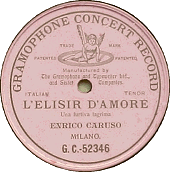
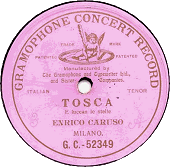
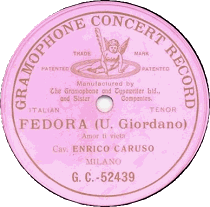
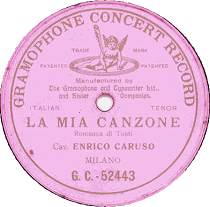
The Caruso Labels
A myth has been circulating
over the past one hundred or more years, which says that the recordings
that Enrico Caruso made in Milan in April 1902 encouraged many other
great artists of the period to step before the recording horn. This
'myth' is greatly exaggerated, if not patently untrue. The renowned
Ivan Tartakov had been recorded by William Sinkler Darby on April
16, 1899. (Alan Kelly intimates that Tartakov might have been persuaded
to record as early as 1897!) Many of the great Russian singers of
the day had been recording since as early as June 1901, including
the Figners, Labinsky, Sobinov, Vialtzeva, Nezhdanova, and even
the greatest of them all, Chaliapin, who made his first recordings
in late January 1902. The Italian tenor Carlo Caffetto had been
recording since July 1900 and the bass Nazzareno Franchi had recorded
in July 1901. The great French baritone Maurice Renaud made his
first recordings in September 1901. Mario Sammarco, Giovanni Gravina,
and Amelia Pinto, all of whom sang with Caruso on March 11, 1902
in the premiere performance of Baron Franchetti's opera Germania
at the La Scala opera House in Milan on March 11, 1902 under the
direction of Arturo Toscanini, had all recorded later that month.
Moreover, negotiations between Francesco Tamagno, the greatest tenor
of the day, and Alfred Michaelis, Managing Director of the Italian
Branch of the Gramophone Company, were already well under way before
Caruso's first recording session.
The issued records
of Enrico Caruso encompass almost the entire acoustical recording
era, and far beyond, even to this present day. The labels used for
them are therefore particularly representative of the changes and
variations used by the Gramophone Company during that early period,
i.e., from April 1902 until about the end of April 1925. Carus's
records, like those of other artists, received labels in different
colors according to the number of artists involved, which also designated
their price categories. Of Caruso's 248 known recordings, only twenty-two
were made under the auspices of the Gramophone Company; the remaining
226, with the exception of ten made under the auspices of the Anglo-Italian
Commerce Company (which encompassed both the Zonophone flat disc
and the Pathe cylinder recordings) in April 1903, were recorded
in America for the Victor Talking Machine Company. Of the 211 VTMC
recordings, 208 were pressed by the Gramophone Company from metal
parts, i.e., stampers, imported from the United States.
Labels on pressings
made in various European countries have distinguishing features.
In August 1907, Caruso's recording of the Quartet from Rigoletto
was issued by G&T with a pale blue label, while his duets with
Antonio Scotti were given pale green labels. Patti's and Tetrazzini's
recordings received pink labels, while those of less outstanding
artists such as De Lucia, Giorgini, Ruffo, Journet, Boronat, Galvany,
and others were issued with standard Red Celebrity labels. In August
1908 Caruso recordings were being issued with pink, darker blue
and green, and white labels, according to the number of artists
(see above). All this was done to assign the various recordings
to different price categories. These colors appear on the labels
in varying shades, due to the difficulty at that period of preparing
batches of ink of the same hue and saturation. None of Caruso's
Gramophone Company recordings were ever issued on double-sided records
during his lifetime. However, see below under ZONOPHONE LABELS.
Through the diligent
efforts of Madame Aida Favia-Artsay (see the Bibliography), a letter
from the office of the Gran Magistero degli Ordine dei Santi Maurizio
e Lazzaro e della Corona d'Italia (Grand Master of the Order of
Saints Maurice and Lazarus and of the Crown of Italy), states that
Caruso was awarded the honor of Cavaliere of the Order of the Crown
of Italy by royal decree on January 4, 1900, and the rank of Commendatore
on February 21, 1907. This singular honor, his first, belies another
myth, that Caruso's fame and recognition were initiated by the success
of his first recordings from the Gramophone and Typewriter, Limited.
None of 66 known labels from the first recording session of April
11, 1902 bear the title "Cav." On the other hand, with the exception
of the labels on the two retakes from the first session, it was
added to all known labels of his recordings from the second session
of November-December 1902, but was dropped again during the pre-DOG
period. At a later date the title "Sig." was added.
The central figures
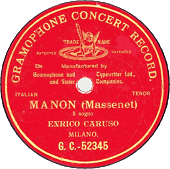
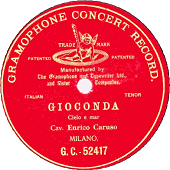
in the two rows of figures below show the large type size. Stamper
III pressings of the same recordings were issued between February
29, 2903 and July 29, 1905, the so-called CO. marking period.
However, we do not know whether stamper II pressings were made before
or during the same period. The right-hand figures in both rows show
the use of non-serif fonts for titles.
| |
|
|
| Stamper
I
Apr 1902 - Feb 1903
|
Stamper
IIII
Feb 1903 - July 1905
|
Stamper
V
Feb 1903 - July 1905
|
| |
|
|
| Stamper I
Nov 1902 - Feb 1903 |
Stamper I
Dec 1902 - Feb 1903 |
G&T label for
Victor
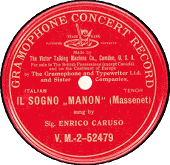
Talking Machine imports |
Caruso's twenty recordings
from 1902 and his two recordings from 1904 by the Gramophone &
Typewriter culminated in the use of some 66 or more stampers for
the first ten, 73 or more stampers for the second ten, 28 for the
1904 10-inch and 12 for the 1904 12-inch recordings, for a total
of not less than 139 stampers for the 1902 recordings and a further
40 for the 1904 recordings; more are possible. Stampers from the
first session were as few as two and as many as thirteen per recording
and those for the second session ranged from three to twelve per
recording. The labels ranged from the G&T through the HMV period.
The variations in these labels have been presented in the articles
by the author listed in the Bibliography. The label variations for
the 1904 recordings are described below.
All
of the recordings in the first session were accompanied by the pianist
Salvatore Cottone, who accompanied most of the soloists recorded
by the Gaisbergs in Milan. By the second session Caruso was well
known enough that several composers deigned to be his accompanist
for their own compositions. Thus, Umberto Giordano was the accompanist
for the recording of Amor ti vieta from his opera Fedora,
in which Caruso sang the world premiere performance in Milan on
November 17, 1898, while Francesco Cilea accompanied Caruso in his
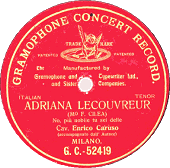
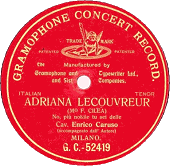
recording of No, non piu nobile from his opera Adrian
Lecouvreur, in which Caruso had sung for the world premiere
in Milan on November 6, 1901. Labels for both of these issues included
the phrase Accompagnato dall'Autore, either with or without
parentheses below the artist's name. It occurs on issues from the
first three stampers used for G.C.-52419, including the period from
February 19, 1903 to July 29, 1905, and up through stamper IV pressings
of G.C.-52439 but not on the Stamper VI pressing shown at the right
below, which was issued following July 29, 1905.
Of the two recordings
that Caruso made in April 1904 under the supervision of William
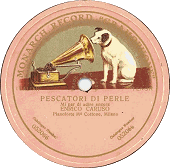
Sinkler Darby, the ten-inch recording shows the name  through
the labels under the Recording Angel trademark from first, second,
and seventh stamper pressings. They are the only recordings made
by the Gramophone Company which bear an artist’s name on the record
surface itself, in contrast to the multitude of such names on Victor
recordings. No such names have been found on late stamper pressings
(IIII, VI, and XII) of the 12-inch recording of Mi par d’udir
from Bizet’s opera Les Pêcheurs de Perles, made in the same
April 1904 recording session. It is interesting to note that the
word is
almost identical with Caruso’s actual signature on a testimonial
written on the Zonophone envelope, as shown below.
through
the labels under the Recording Angel trademark from first, second,
and seventh stamper pressings. They are the only recordings made
by the Gramophone Company which bear an artist’s name on the record
surface itself, in contrast to the multitude of such names on Victor
recordings. No such names have been found on late stamper pressings
(IIII, VI, and XII) of the 12-inch recording of Mi par d’udir
from Bizet’s opera Les Pêcheurs de Perles, made in the same
April 1904 recording session. It is interesting to note that the
word is
almost identical with Caruso’s actual signature on a testimonial
written on the Zonophone envelope, as shown below.
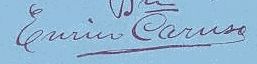
Caruso’s signature
The
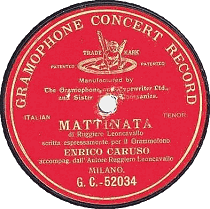
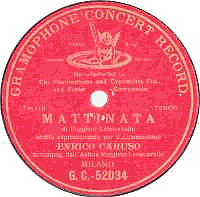
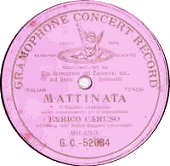
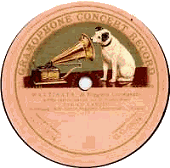
labels from two original stamper pressings shown below are quite
different. The selection title "Mattinata" on the (probably)
early label is 42 mm across, while that on the (probably) later
label is 52 mm. across. On the former the words TRADE and
MARK are closely spaced, while on the latter they are widely
spaced. On the former the two words PATENTED are considerably
larger than on the latter.
These labels are
shown below.
It
becomes apparent from these two labels that it was necessary for
the Hanover plant to print a second batch of labels for these stamper
II pressings before the stamper itself was worn out. We are
thus left with two quandaries, the first being the number of acceptable
pressings that was possible from a given stamper at this period,
and the second being the number of labels per batch that were ordered
from the printer! The author’s calculations from other information
indicate that about 350 acceptable pressings could be obtained from
each stamper at this time. It would therefore appear that the number
of labels ordered in a batch were somewhat less than that number.
[Author’s note:
one may conjecture that the steps required to press one more or
less finished record included 1) placing a softened quantity of
shellac compound into the hydraulic press, 2) putting the label
in place, 3) pressing the record, 4) cooling the finished pressing,
and 5) removing the record from the press. This process may have
taken about one minute by an experienced technician, who could have
pressed some 360 records in an 8-hour working day, with the usual
time off. This provides one with a very approximate figure for the
number of pressings that could have been made from one stamper before
it was could no longer be expected to produce audibly acceptable
records.]
Depending on public
demand and the period in which they were issued, many recordings
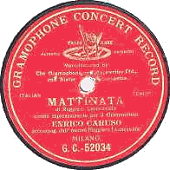
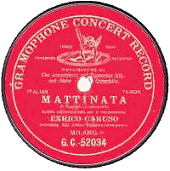
may be found with labels of different designs. For example, G.C.-52034,
Caruso’s 1904 recording of Leoncavallo’s "Mattinata," with
the composer at the piano, proved to be extremely popular. One can
estimate that some 24,500 records were pressed. Six labels from
forty-seven known stampers are shown below. The stamper XXVIII
pressing shown below indicates that some 98,000 copies had been
pressed during the slightly more than three and one-half years between
the original recording on April 8, 1904 and the end of the G&T
label period in November 1907. A stamper XXXIX pressing with
a pre-DOG pink label indicates that it had been pressed after July
29, 1905, while the pressings from the previous stamper had been
made before that date. The stamper AH (37) pressing, made
before August 1910, indicates an additional 3,000 records produced.
A German pressing from stamper MH (47) is also known.
| |
|
|
| Stamper
II |
Stamper
II |
Stamper
VII |
The
labels on two stamper II pressings of this recording appear
to be identical. However, they differ by the spacing of the words
TRADE
and MARK.
It may be noted further that this recording is one of three by Caruso
that indicate on the label that he was accompanied by the composer,
in this instance, Ruggiero Leoncavallo. The labels from all issues
of the Mattinata recording bear this inscription, even on
the HMV label as well as on the pirated German Schallplatte label.
In contrast, the label for the selection Amor ti vieta bears
this notation up through stamper III pressings, but not on
a stamper VII label. The phrase was also used on Caruso’s
recording of No, non più nobile, G.C.-52419 (see above).
| |
|
|
| Stamper
XXVIII |
Stamper
GL(=18) |
Stamper
AH (=37) |
| |
|
|
| Stamper
VIII |
Stamper
VII |
Stamper
IX |
Three recordings
from the first session and two from the second session were issued
with original G&T labels following the change in the red Celebrity
color to pink, as shown above.
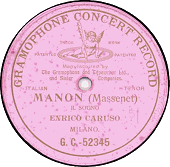
Three pre-DOG labels
from the first G&T session and one from the second session have
also been seen, as shown below. These four recordings continued
to be processed and issued between November 19, 1907 and February
1909, after which date the DOG trademark became the standard for
all Gramophone Company labels. G.C.-52347 required ten stampers,
indicating a probable total printing of about 3,500 issued records.
The issued records of G.C.-52349 used nine stampers, for a total
issue of some 3,200 records. (Author’s note: it is probable that
between 1903, from which the estimated stamper usage is calculated,
and the beginning of the pre-DOG label in late 1907, considerable
advances were made in record processing technology. It is quite
possible that by that date a stamper could press 500 or more records
before wearing out.