Elvis Presley
CD and Vinyl

Early British Disc Record Labels 1898 to 1926.
(Back To Early Records Alphabetical List)
 |
|
|
|
|
 |
 |
|||
|
||||
| Frank credits David
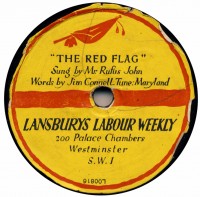
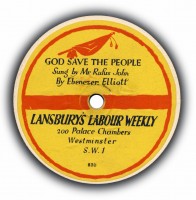
Mason for providing most of the info. on this scarce label. George Lansbury
(1859-1940) was a Labour Member of Parliament very early on, in 1910.
He founded his eponymous magazine in 1925. It lasted for about two and
a half years, when it merged with the Labour Party’s official publication,
the New Leader. Having published socialist songs and music in his paper,
he progressed to making records, but encountered much opposition. Most
record companies refused to record the songs, which they regarded as inflammatory.
However, David Sternberg, of the British Homophone Co. Ltd., allowed the
use of his then-obsolete acoustic equipment. Then, there arose the difficulty
of having them pressed; Homophone’s discs were pressed (as well as recorded)
at this time by ‘mighty HMV’, who would have nothing to do with Socialist
songs, as was only to be expected! Eventually, the Pathé concern pressed
them – but insisted they carry plain white labels, so as not to engender
argument among their workers. The labels, perforce, had to be stuck on
by hand. On ‘The Red Flag’, which is quite a long record, the sticking
on has not been done very well; but on ‘God Save The People’ it is much
neater, and the edge of the underlying white label shows around the edge.
On ‘The Red Flag’ & ‘International’, Rufus
John was a pseudonym for baritone John Goss, who was an HMV artiste, so
that company was indirectly involved after all! The other disc above is
sung by a tenor, name presently unknown. There were only six issues altogether,
made between July 1926 and March 1927, and all were acoustic. |
||||
|
||||
 |
 |
|||
|
||||
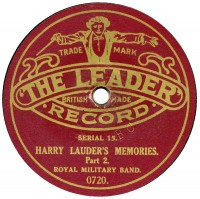
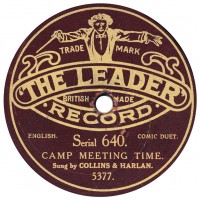
| A very elusive label,
which even Frank declines to date precisely. He feels that it might have
been a ‘tallyman’ label (see e.g. John Bull and Meloto) and in
view of the scarcity of them, one which may have failed during the price
wars of 1913, which drove the price of cheap records down to just 1/-
(5p). They were never advertised in the Trade Journals. Or, they may have
been made for one particular dealer or client, as yet unknown. (However,
in BRI Frank notes that Mead & Co. of Liverpool were selling
phonographs and cylinders called ‘The Leader’ in 1903 and subsequently
for some time. It is possible that The Leader disc records were also made
for Mead & Co.) Frank is confident, however, that they were manufactured,
in this country, by the Disc Record Company. This concern had accumulated,
in various ways, a large number of masters from a variety of sources.
These they used to press discs at the cheaper end of the market. Their
stock-in-trade included stuff from Beka, Bel Canto, Dacapo, Favorite,
Nicole, and U.S. masters from the defunct Star Records and the American
Record Company, as witness Collins & Harlan on 640. ‘The Leader’ remains
very much a label of mystery; and though its inception is unknown, it
cannot have carried on much after late 1914, as the Disc Record Co. went
to the wall in early 1915. The significance of the ‘Special’ label on
the right is not yet known. |
||||
|
||||
 |
||||
| |
||||
| The London wholesaler
Leon Leibowich & Co., offered, in 1909, postcards and playing
cards that were also gramophone records. These were thus the first
in very long line of talking or musical cards – different forms of them
appeared for many decades. See Dr. Rainer Lotz’s extensive & fascinating
article on such recordings at http://www.lotz-verlag.de/Online-Disco-Phonocards.html
On the basis that neither Frank nor Dr. Lotz know their origin, we may
be certain that they are very scarce indeed. Leibowich also had bankrupt
stock of Edison Bell ‘Bell Discs’, and some other, un-named label in late
1909 and early 1910. He must have done all right with these, as he soon
had his own labels made, such as Besttone, Pickofall, Playwell & Fortune. |
||||
|
||||
 |
 |
|||
|
||||
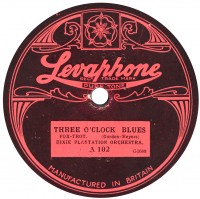
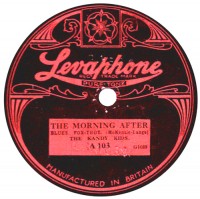
| The proprietor, Jack
Levy, first sold cylinder records around 1900-1901 from a stall in an
open market in London. Later, he opened a long-lived shop in Whitechapel
which he eventually called ‘The Home of Music’. He had Olympic
records made for him, starting about 1913. These seem to have continued
for 12 or 14 years. Another slogan was ‘Foreign Records a Speciality’:
if you knew of a record’s existence, Levy’s could probably
import it for you. The shop became a Mecca among the earliest jazz record
collectors. (This woefully under-researched period began around 1925.)
Sensing a niche market, Levy’s created Levaphone in late 1925 or
early 1926, and had ‘hot’ sides issued thereon, drawn from
U.S. Vocalion. True, there was only one issue of 3 discs, but this represented
a remarkable development in the British retail record trade. In 1927,
further Levaphones appeared in an L- series. There are about 15 of them,
all by Ukulele Ike (Cliff Edwards), from U.S. Pathés dating from two or
three years earlier. As they were mechanical recordings, they qualify
for inclusion here. Later, Levy’s Oriole discs appeared (again with
Hot Music), but those were electrically recorded. Subsequently, Levy’s
had two private recording studios in central London. Eventually, they
built a pressing plant and Oriole became a ‘major minor’ label
and the plant was a prolific source of custom pressings . A fascinating
story, but far beyond our time period. |
||||
|
||||
|
||||
|
||||
| Lilliput Records
were 5″ (12.75 cm) double sided records. A product of Homophon,
they were first advertised in the British trade press in September 1905.
Like the 10″ Homophons (single and double sided) that were also
introduced at the same time, they had to be ordered direct from the maker
in Berlin. Frank believes that about 75 Lilliputs may have come out here.
By December 1906, a British agent had been appointed: Bernhard Andrés
& Co. I have never seen a Lilliput; they cannot be common. Their companion
single sided Homophones are very scarce too: the sales of both these must
have been fairly modest. |
||||
|
||||
|
||||
|
||||
| A ‘mini-disc’ label
produced by ‘Edison Bell’, for an unknown client. The above example is
5 & five-sixteenths of an inch in diameter (13.3 cm). The other side
is ‘Shine’, the Ford Dabney title that was current in the U.K. in 1924. |
||||
|
||||
 |
 |
|||
|
||||
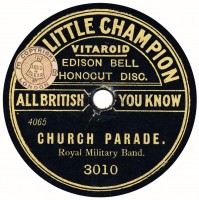
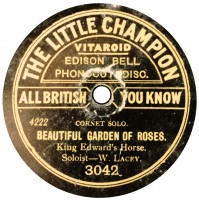
| These scarce discs
were made by the concern loosely termed Edison Bell. Bearing in mind that
it was a very old one, having made cylinder records as long ago as ca.
1890, it was ‘married’ as it were, to the old vertical cut method of recording,
as originally used on phonograph cylinder records. Although they boldly
began to make lateral cut discs in 1908 (Bell Disc), they evidently retained
an affinity for the old system. Therefore they were to introduce two vertically
cut discs. The first appeared in 1908 – the short-lived Phona-Disc.
Those sixty-odd issues disappeared almost instantly and virtually without
trace. Either slow to learn, or perhaps because in 1910 there were, to
be fair, many gramophones around which were intended to play vertically
cut discs (Pathé, Neophone, Musogram &c.) they brought out ‘The Little
Champion’ record, at the slightly odd price of 1/4d. There were only 53
issues, which were terminated in 1911. Little Champions are less rare
than Phona-Disc, at least in my opinion. I have had three in 55 years,
vs. no Phona-Discs at all. At any rate, Edison Bell finally (and
perhaps with some relief?) shrugged off the vertical cut format for the
rest of its existence. Some of 3049 can be heard on YouTube at http://youtu.be/hRAOmL3UAM0
One curiosity is that 3010 bears copyright stamps These first appeared
in 1912, so some sales must have occurred until then? The rough pencil
marking on its packet might be the number nine. If so, it would probably
mean the discs were being sold off cheaply at ninepence. |
||||
|
||||
 |
 |
|||
|
||||
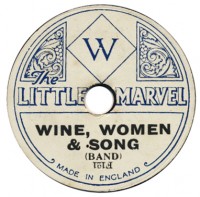
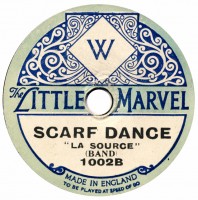
| See Arthur Badrock: TMR 95, 96, 1996-97. A provisional listing appears in these two issues. Arthur states that recordings were first made in 1922, but some were not issued until later, but still fall in our period of interest. The earliest Little Marvels were 5.375″ diameter (13.5 cm) diameter, and were made by ‘Vocalion’ for Woolworths stores, where they were sold for 6d (2.5p) each. 6.5″ discs appeared later. They sold well and still turn up. They have no artiste credit: just the title and the type of material – e.g. ‘Song’, ‘Band’ &c. From the first they inevitably employed the system common to very cheap labels, of having a copyright work only on one side. The minimum royalty was one half-penny per side. If both sides carried a royalty, that was one penny (1d) per disc. But on a disc selling for sixpence (6d = 2.5p) then a royalty of one penny represented one sixth of the retail price, or 16.6%. Yet the Copyright Act only demanded a royalty of 5%! There was no choice then: there had to be some new copyright stuff: but all were backed by non-copyright material, as in the case above. Even then, this Little Marvel was paying a royalty of ½d on sixpence on its other side – or 8.3%, as opposed to the more lenient 5% rate for more expensive discs. Moreover, the copyright stamp covered the ‘W’ signifying Woolworths. | ||||
|
||||
 |
||||
|
||||
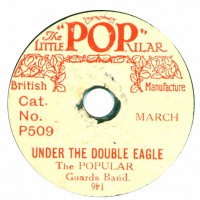
| A product of the Sound Recording Company, whose label at the time was ‘Popular’. They were introduced in January 1922, and were 5.5″ (14 cm) diameter, and double sided. The same company had been making single sided Mimosa records of the same size since 1921. Those were exclusive to Woolworth’s stores; so perhaps the Little POPular was brought out to enable other retailers to offer these small discs? (We have left the B&W image here, which was the first one we had, and thank Mike Thomas for sending an example in the proper colours.) | ||||
|
||||
 |
||||
|
||||
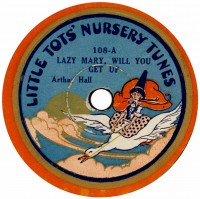
| A product of the Plaza Music Company of New York, U.S.A., whose main record label was Regal (no connection with the British label of that name). They appeared in 1923 and were subsequently imported here in October of that year by the factor Barnett Samuel, proprietors of Decca gramophones among other things. 7″ (18cm) in diameter, they came in albums containing three – later four – discs, plus coloured picture cards, with the story, or words of the song, printed on the back. The three-disc books originally cost 4/- (20p), which was 5p for each disc & 5p for the book or album. They were still available in late 1926. Nine books were issued in all, the discs being numbered in a 100 series. | ||||
|
||||
 |
 |
|||
|
||||
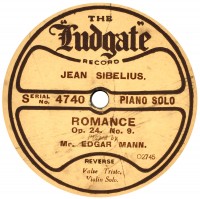
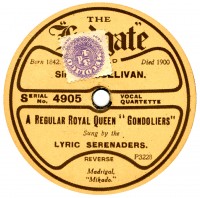
| Ludgate records belonged to Messrs. Dollond (makers of scientific instruments and ‘Experimental Electrical Apparatus’). They were evidently branching out, commendable for a concern that dated back to 1750! Their head office was in Ludgate Hill, London. There is an advert. for them in 1924; Frank informs us that there are two sources. Some Ludgates (probably a minority) were pressed by Crystalate using Grammavox and Popular masters, dating back to 1912. Of course, in the absence of electrical recording that didn’t matter – most Grammavox masters were well recorded. However, most Ludgates were pressed by the Universal Music Co. (often loosely called Vocalion) at their Hayes factory, as were many other marques: e.g. Scala, Coliseum, Guardsman, Homochord &c. On 6087, the side shown is a British recording of November 1923; but the other side is by Rudy Wiedoeft’s Saxophone Sextet, drawn from U.S. Vocalion. 4740 is a British recording, originally issued on Aco F-33029 and credited to Francis de Bourguignon. 5203 is a resurrection of one side of Guardsman 521 of ca. 1915, when it was credited to the Mozart Symphony Orchestra. The label is pretty elusive. There were also Ludgate gramophones. Frank thinks their involvement in the music trade was relinquished in 1927, when the firm Dollond & Aitchison was formed, which still flourishes today. | ||||
|
||||
.jpg) |
 |
 |
||
|
||||
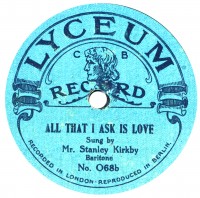
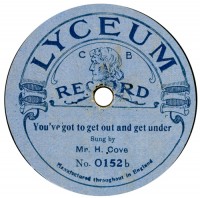
| There were two distinct incarnations of Lyceum. The ‘C B’ on the label stands for the wholesaler Cooper Brothers. Since 1912, CB’s only label had been Coliseum, but they must have felt another was needed, as the price war was raging in late 1913, and cheaper and cheaper discs were required. An initial batch of 87 discs, made in Germany by Beka, appeared first, by November 1913, in time for the Christmas trade. The colour of O-68 is an unusual variant – its other side is normal. However, the series did attain O-200 – but by this time War had broken out, and O-152 above is ‘manufactured throughout in England’. This type would have been pressed at the Lindström works in Hertford. Frank informs us that the (newly re-founded) Wm. Cooper Bros. Ltd. concern stopped promoting Lyceum records from November 1917. There was, however, a second incarnation of Lyceum a year or two later in an O-2000 series. Frank knows only of four examples, O2009 being the highest. These last issues, derived from the Sound Recording Co., ‘Popular’ masters and pressed by Crystalate, probably date from 1918-20 and are very scarce indeed. As you can see, they are printed on a much darker blue paper, and since the type is in dark blue as well, the labels are not terribly legible! In Lyceum we have a classic example of an always elusive label, yet which was produced in three different factories, with three quite different sources of repertoire none of which was actually original to Lyceum. | ||||