Elvis Presley
CD and Vinyl

Early British Disc Record Labels 1898 to 1926.
(Back To Early Records Alphabetical List)
 |
|
|
|
|
 |
 |
 |
||
|
||||
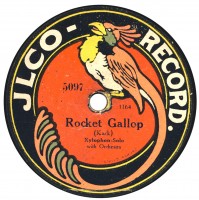
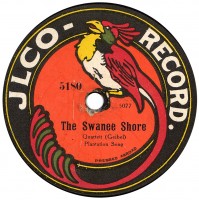
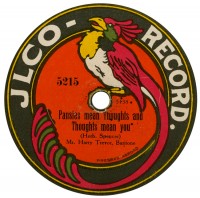
| The scarce –but gorgeously labeled – Ilco records were produced in Germany for I Lange & Co. of Berlin. Who distributed them here is unknown. They used masters also to be found on Aga, Bel Canto and Dacapo. In the case of sides as on Bel Canto – such as the ones on 5215 above – the catalogue and master numbers are both in a 5000 series. The Lange company was reported as in liquidation in April 1912, so this was a very transient label indeed, as was the equally sumptuously labeled Bel Canto. Probably just a few months in late 1911 or early 1912. February 2013: We are grateful to Dr. Rainer Lotz for reminding us that this label is actually ILCO and not JLCO – the ornamental letter ‘I’ having apparently tripped up Frank Andrews, which takes some doing! In fact, the letter ‘J’ (along with Q, X and Y) are extremely scarce in German – so an ornamental foot to the letter ‘I’ is perfectly in order. An ‘I’ with a similar foot occurs on the German Invicta label; but this would not mislead an English speaker. | ||||
|
||||
 |
 |
|||
|
||||
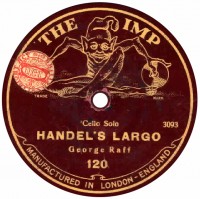
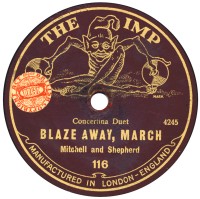
| In TMR 90, John Booth, the editor, reproduced an IMP label in monochrome, and asked for any further information. The label colour was not stated. In TMR 91, Frank Andrews replied that these were produced by ‘Edison Bell’ from Bell Disc and possibly Winner masters. The proprietor is unknown. Curiously, Frank reveals that no less than four of these IMP records have been found in the U.S.A. As they are practically unknown in the U.K., one is forced to conjecture whether they were made here for export to the U.S.A? This seems to us rather unlikely, as the USA generally had high import tariffs. Some of the sides date from 1908; but the IMP in TMR 90 (as also two here) has a copyright stamp; these came in in 1912. Still, the presence of a copyright stamp at this early period is not, we think, proof that the disc was definitely sold in the U.K. There are instances (also involving ‘Edison Bell’ as it happens) of Minstrel and Herald records made for J E Pidgeon in New Zealand, which have been seen with U.K. stamps. Perhaps in those early days it did not matter whether the royalty was paid in the country of manufacture or the country of consumption? Anyway, IMP records, needless to say, are very scarce indeed. Perhaps the rather sinister appearance of its eponymous being is to blame? | ||||
|
||||
 |
 |
 |
||
|
||||
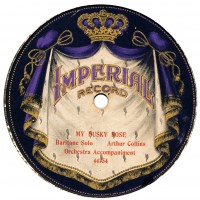
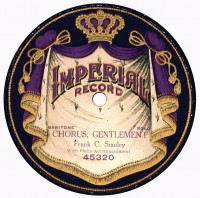
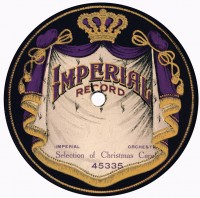
| The C.L.P.G.S. recently published No.33 in their Reference Series. This contains 36 pages of the history of the various Imperial labels, from 1907 to early 1937. It also contains a CD-ROM, which has a searchable list of the several thousand discs that appeared on these. Go to www.clpgs.org.uk/reference-series.htm to get your copy! Also see Frank Andrews: FTR 2, 2002, pp73-5, and TMR 69, 70 (1984-5). Frank’s comprehensive write-up was revised & is included in the above Reference Series booklet. These first Imperials were made by the U.S. firm Leeds & Catlin of New York, and imported to the U.K. beginning about April 1906. They were single sided. 600 issues were available by January 1907. The small (~1.5") ‘back-sticker’ is present only on some (early?) examples. This is probably because the sticker stipulates that the discs may only be used on a machine with a feed-screw – like a cylinder phonograph. This was part of a dodge to avoid infringing a U.S. patent. Surprising as it may seems to us, the fact that the sound-box playing a disc was carried across the disc by the very groove which it was tracking, was a crucial patent in the U.S. at the time. But as far as I know, it was totally irrelevant in the U.K., so eventually, no back-stickers? Imperial had some recordings, of exalted status, made for them in Europe, by Favorite. By way of contrast, in 1907 the famous Scottish baritone Ian Colquhoun went to the U.S. and recorded over 30 sides, presumably mainly for the British market. However, in 1909, after long-ongoing patent litigation, Leeds & Catlin were compelled to stop manufacturing discs. The residual stock was sold off cheaply; in this country, largely by Gamages. Single sided Imperials are quite scarce. Some of the Favorite sides were issued in the U.K. at higher prices. They had a different, black label featuring just the crown, and are excessively rare. In 1911 the trade mark was acquired by the Sound Recording Company. | ||||
|
||||
 |
 |
 |
 |
 |
|
||||
 |
 |
|||
| |
||||
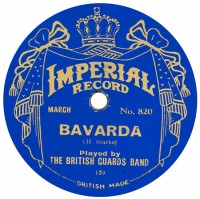
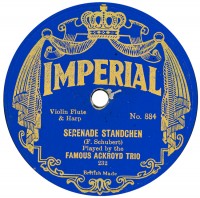
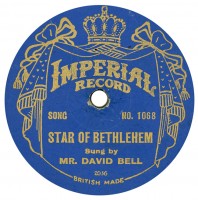
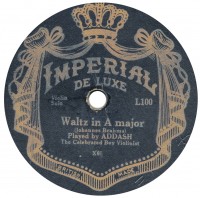
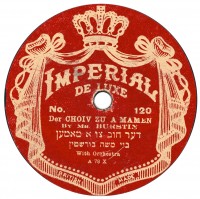
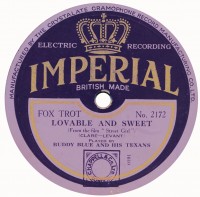
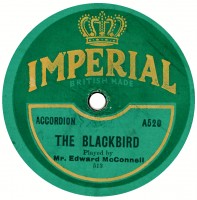
| The C.L.P.G.S. recently published No.33 in their Reference Series. This contains 36 pages of the history of the various Imperial labels, from 1907 to early 1937. It also contains a CD-ROM, which has a searchable list of the several thousand discs that appeared on these. Go to www.clpgs.org.uk/reference-series.htm to get your copy! Also see Frank Andrews on Crystalate: HD 134, 135, 136, 1983. This series of articles concerns a company of vital importance to the British record industry. It always claimed to be the oldest maker of disc records in this country. It is impossible to make a short abstract of what Frank says; you really should try to get back numbers of HD. Suffice it to say that the company existed from 1901 and soon made itself indispensable by its contract pressings, beginning with Nicole in 1903 (though in this case they probably only supplied the materials). You will see on these web pages, many, many labels that were pressed by Crystalate, who had factories in and around Tonbridge in Kent. Still, it was not until late 1922 that they had their own label, seen here. The name Imperial came indirectly from the U.S. disc of that name, via the Sound Recording Co., which was eventually taken over or absorbed by Crystalate in about 1922. They already had large quantities of masters on their shelves, including those for the SRC’s Grammavox label, as well as Popular and Bull Dog records. Apparently, catalogue numbers from 999 downwards were assigned to these earlier sides, and that 1,000 and above were assigned to new recordings, plus futher delvings back into their ‘shelf stock’. E.g., Imperial 1068 above is derived from 1913 Grammavox masters. (‘David Bell’ is in fact the well-known Welsh singer David Brazell.) Imperial 820 is well towards the bottom of the range of catalogue numbers; it bears 2 marches that were originally issued on Grammavox in June 1912. Certain 1916 sides by banjoist J.J. Ashton (from Bull Dog) were issued on Imperial and remained in catalogue until Imperial ceased in 1933, to be replaced by Rex, but that is far beyond our time period. The Imperial label was very successful (if almost always ‘cheap & cheerful’); they are common to this day. However, the early red (and black) ‘Imperial De Luxe’ discs are very scarce, and new issues were abandoned early on. Later, several more specialist series appeared, including Scottish, Swedish, Jewish, and even a few in Taal (a predecessor of Afrikaans). Though issued in 1926, the sides on the Irish series A-520 above were from the American label Emerson. They had been recorded in New York, 1919/20, by John J Kimmel. | ||||
|
||||
 |
 |
 |
 |
 |
|
||||
 |
||||
|
||||
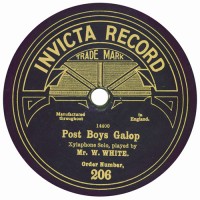
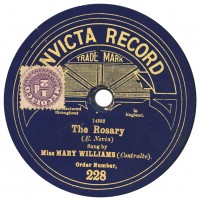
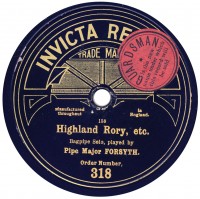
| A relatively complete listing of Invicta and Guardsman records
was privately published in 2010. (The Invicta label was re-named Guardsman
in early 1914). It was compiled by this writer, principally from data supplied
by the late Arthur Badrock and by Frank Andrews, but also by many other
contributors. Only 30 copies were printed, and to our surprise, these were
quickly taken up. Invicta appeared in November 1912. Its original proprietor,
William Barraud, was the brother of Francis Barraud, the painter of ‘His
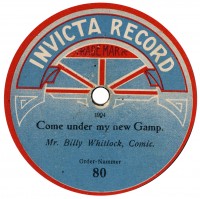
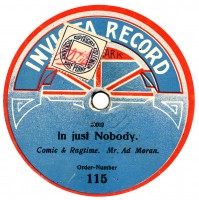
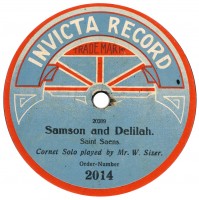
Master’s Voice’ fame. William had already been the British agent for Dacapo records, and when Dacapo opened their own direct branch in London, he looked for another line. He took on Invicta records, which were made in Germany by Berolina. Unfortunately, after only a few months, a disagreement arose, and Berolina appointed another agent, John Abrahams. Abrahams continued to sell the red white & blue German Invictas right up until August 1914, when supplies obviously ceased, at around catalogue number 380. The split occurred in mid-1913, at Cat. No. 270. Barraud believed that he had the rights to the name Invicta, and so got Invicta records pressed here. These are the ones with the blue labels. At first he went back through his original catalogue, trying to get the same artistes to record the same selections. It is important to realise then, that blue Invicta 206 above, though it carries the same titles by the same artist (Billy Whitlock) as are found on red white & blue Invicta 206, they are different recordings made many months later. These remakes all have master numbers between about 14370 and 14639. Besides this, Barraud needed new recordings. These were made in a new 100 master series. The trouble was, that he carried on with the catalogue number 271. Thus, absurdly, there were two different Invicta labels both using the same catalogue numbers – and, of course, carrying completely different artistes and repertoire! This outlandish state of affairs continued for several months, creating a nightmare for future discographers. Briefly, a court found against Barraud regarding the name Invicta, so he changed the name of his label to Guardsman, which began at 340. The red sticker above was attached to his remaining stocks of blue Invictas. |
||||
 |
 |
 |
 |
|
|
||||
|
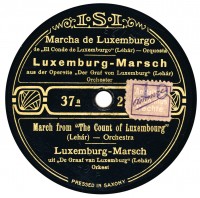
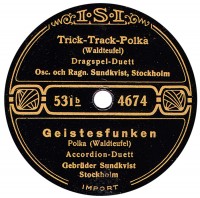
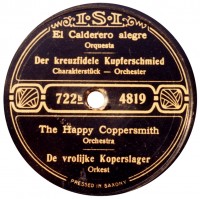
I.S.I. records were made by the German concern International
Schallplatten Industrie, of Leipzig. Their trade mark was registered (in
Germany) in February 1910. As you see, their label had I.S.I. quite small,
right at the top, and most of the rest of the label is devoted to titling
in a number of languages, drawn variously from German, French, Italian,
Spanish, Dutch and English. The first label above has a German (AMMRE)
copyright stamp: this would be good for sales in any of the four countries
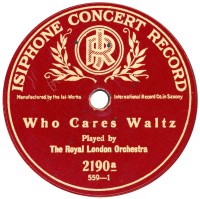
indicated by the language. English only labels are also known. These were
announced in February 1912, and were pressed from London-made (and perhaps
other) recordings, under the ‘Isiphone Concert Record’ name. They are
extremely scarce. Another ISI label was ‘Symphony Concert’, intended for
U.S. consumption, but carrying British material. |
||||
|
||||