Elvis Presley
CD and Vinyl

Early British Disc Record Labels 1898 to 1926.
(Back To Early Records Alphabetical List)
 |
|
|
|
|
 |
 |
|||
|
||||
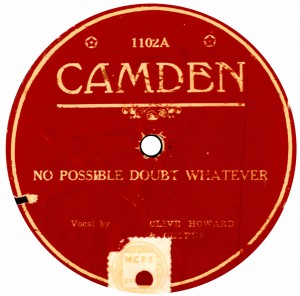
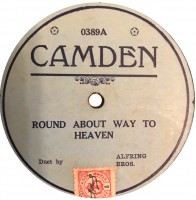
| We believe that underneath these Australian Camden labels, we will find a British Vocalion. In 1927, Vocalion introduced their 8"Broadcast label, having given up making 10" discs. Remaining stocks of the latter were jobbed off and exported to Australia, where Camden labels were affixed. So some Camdens will be electrically recorded, and some by the old mechanical system. It is the latter that qualifies them to appear on this page. There was also a light blue label of the same design with dark blue printing. | ||||
|
||||
 |
 |
 |
||
|
||||
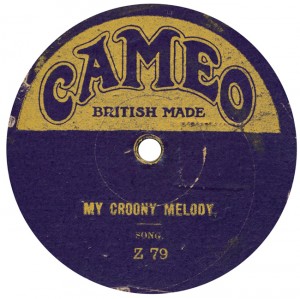
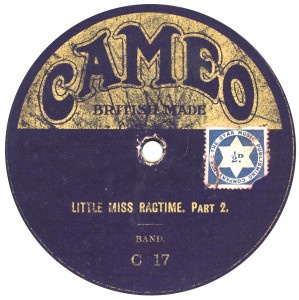
| Cameo records date from December 1916
to as late as 1921 – but were probably not continuously available during
that period. All Cameo labels are stuck over Columbia-Rena, Regal and Phoenix
records. The Columbia concern evidently had large stocks of these to clear,
and the trade mark Cameo was registered to Columbia in 1915, they must have
gone about it in a logical way. The first ‘wave’ of Cameos were sold by
G Gilbert & Co. of Sheffield, at just 1/- (5p) each, a very attractive
price, as during the war, the price of records – and everything else – gradually
rose. These first Cameos had a C- prefix. By October 1917, about 100 were
available. None bore artiste credit, simply describing the performance:
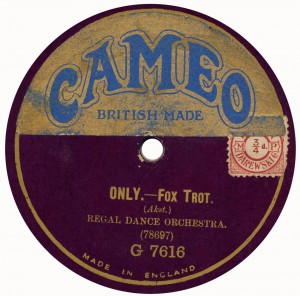
‘song’, ’band’ &c. It was discovered that the Z- series seen above consisted only of Regals deleted in August 1918 and March 1921. Therefore there might be as many as three ‘waves’ of Cameo: the first (C- series), probably the largest one, sold by Gilberts, probably to exhaustion; then a second batch (Z-) which may or may not have gone via Gilberts, and dating perhaps to late 1918; then a final wave (Z-) in say mid-1921. The copyright stamp on the Regal can be seen under the label of Z-79. The blue-lettered ‘half label’ stuck over Regal G-7616 is from another separate venture or disposal; these were sold in Australia by an unknown vendor. |
||||
|
||||
 |
||||
|
||||
 |
 |
|||
|
||||
 |
 |
 |
 |
|
| |
||||
 |
 |
|||
|
||||
 |
 |
 |
 |
 |
|
||||
 |
 |
 |
 |
 |
|
||||
 |
 |
 |
 |
 |
|
||||
 |
 |
 |
 |
 |
|
||||
 |
 |
 |
 |
|
|
||||
 |
 |
 |
||
|
||||
|
|
|
|
|
|
||||
|
|
|
|
|
|
||||
|
|
|
|
|
|
||||
|
|
|
||
|
||||
 |
 |
 |
 |
 |
|
||||
 |
 |
 |
 |
 |
|
||||
 |
 |
 |
 |
 |
|
||||
 |
 |
|||
|
||||
 |
 |
 |
||
|
||||
 |
 |
 |
 |
|
|
||||
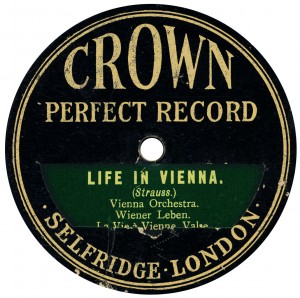
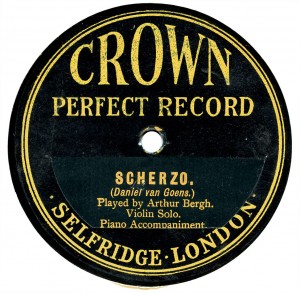
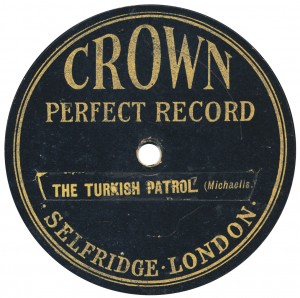
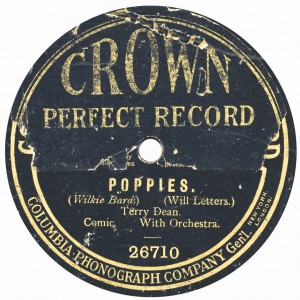
| Crown Perfect Record:
Arthur Badrock, in his ‘Junkshoppers’ Column’, tells of early single-sided
Columbia discs over-stuck with a label bearing the name Crown in large type,
under which appears ‘Perfect Record’, and Selfridges – the London department
store. The label has a slot cut out of it, to reveal the title and artiste
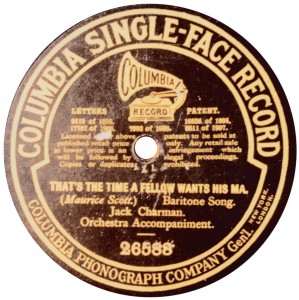
(sometimes just the title) on the original Columbia label underneath. The discs were recorded not later than 1905. Frank Andrews informed Arthur that single-sided Columbia were all deleted in 1908, so you may surmise that Selfridges bought some – or all – of the remaining stocks and stuck their own labels on them. Seven examples turned up together, but Arthur had never seen one before, thus making this label exceptionally scarce. Also we can also show another type, which differs by having only a ‘half-label’. Thus, Selfridge’s are not mentioned, and the disc actually displays not only the original Columbia catalogue number, but also the rightful maker. Obviously, we wonder which sort came first? Well, many early single-sided Columbias carried a ‘back sticker’ – a printed label listing patent numbers, resale price maintenance &c. (one type of these – there were several versions – may be seen under Columbia, above). Reports state that the ‘back sticker’ on one of these discs have been covered up with black paper. This must have been tedious, not to mention the cutting out of variously-shaped slots in the full Crown Perfect label. Accordingly, it is suggested that this ‘fiddly’ procedure was employed first; and that later, Selfridges abandoned it, settling for the half-label, either with or without the approval of Columbia. (26710 has no ‘back sticker’ anyway; its use was eventually abandoned by Columbia – another indicator that the half label is later?) |
||||
|
||||
 |
 |
 |
 |
 |
|
||||
 |
 |
 |
||
|
||||
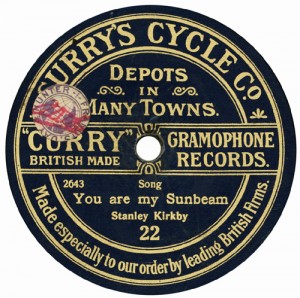
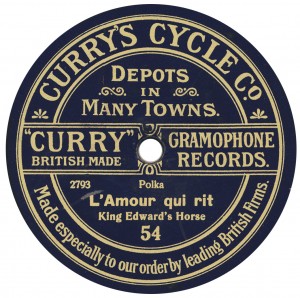
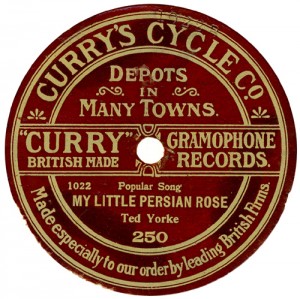
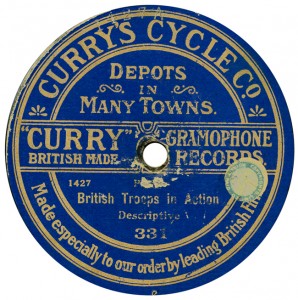
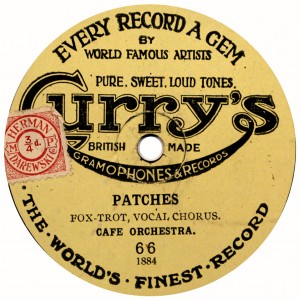
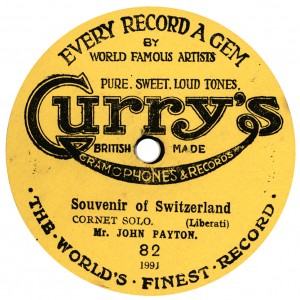
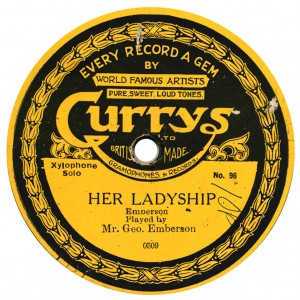
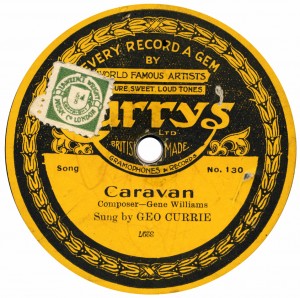
| These ‘Curry’
and ‘Curry’s’ records illustrate a largely forgotten aspect
of the early British Gramophone Trade: viz., the ‘Gramophone and Bicycle
Shop’. They made excellent partners, for both trades were very seasonable.
Those who could afford to do so, purchased bicycles in the summer, and phonographs,
gramophones and records in the winter months; especially when the price
of the machines and discs crashed after about 1910, progressively to 1914. Curry’s was probably the first ‘chain’ of these shops; they already had ‘Depots in Many Towns’ as early as 1910, when the first series of discs above, drawn from Edison Bell ‘Bell Disc’ appeared. The first yellow label issues are derived from Guardsman. The last two discs date from about 1924, and the first bears a Grammavox master dating from about October 1913. And the rest is history. A century later, the nationwide chain of Curry’s Discount Warehouses stand in the forefront, everywhere! “The U.K.’s Foremost Electrical Retailer” is their byline. There was evidently money – lots of it – to be made from bicycles and records, as long as you managed the business well. Later they had other labels, called Portland and Westport. They seem to have abandoned records by about 1930; but that is beyond the scope of these pages. |
||||
|
||||
 |
 |
|||
|
||||