Elvis Presley
CD and Vinyl

| Early British Disc Record Labels 1898 to 1926. | ||||
| (Back To Early Records Alphabetical List) | ||||
 |
|
|
|
|
 |
 |
 |
||
|
||||
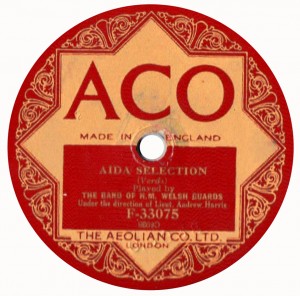
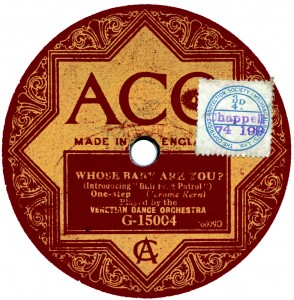
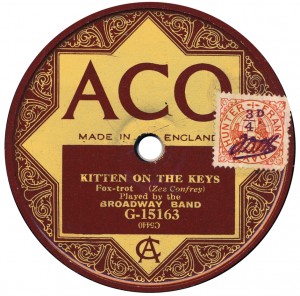
| Collectors often loosely refer to ‘Vocalion’ as an umbrella term for 3 or more different companies. Originally there was the Orchestrelle Co. Ltd., which later ‘became’ the Aeolian Co. Ltd. Its records were pressed by a subsidiary company, the Universal Music Co. Ltd. at a factory in Hayes, Middlesex. The ACO trade mark was registered to Aeolian in July 1922. The first Aco discs appeared in November 1922. Aco was in effect a ‘budget label’ to Aeolian’s high-prestige Vocalion marque. Aeolian had just bought up the Invicta Record Co. Ltd., whose label was Guardsman, and most of the first 40 or so Aco issues were derived from Guardsman masters, some of them quite old. The label continued until G-16230 in 1927, but does not turn up all that often. They also put out at least seventy-five 12" discs in a F-33000 series. These are very scarce. Just for the record, the Vocalion Gramophone Co. Ltd. was formed in December 1924, so only products after that date (they manufactured many other labels) really merit the loose term ‘Vocalion’. | ||||
|
||||
 |
 |
|||
|
||||
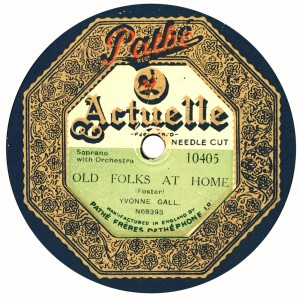
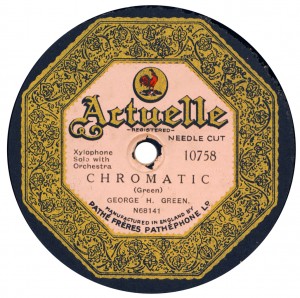
| Actuelle was a product of Pathe Freres
and was Pathe's "needle-cut" disc (i.e. lateral cut grooves) as
opposed to vertical cut or "hill and dale" as it is now often
referred to. Actuelles appeared in Britain in September 1921 and lasted
until December 1928. The records used English, French and American Pathe
masters throughout. Initially, these were dubbed from a master cylinder
recording, generating quite considerable "cylinder rumble" on
some records. The surfaces of the records were always very smooth, though.The
English masters were in a 78000-79000 and 90000 series, the American ones
ran from 68000 to 70000, then restarted at 105000, reaching somewhere in
the 108000 range. French matrices were in a 5000-6000 block. Electrical
recording came quite late; only one or two English matrices on Actuelle
are electric; the American masters went electric at about 107100, though
some early electrics have matrices in an E-2000 range. All English dance records are by studio bands led by Wag Abbey, though the electrics are actually French bands (despite having English matrix numbers); American ones include the usual Sam Lanin, Lou Gold, Ben Selvin etc. There was quite a lot of interesting Jazz issued, such as The Red Heads and The Original Memphis Five.Columbia bought the English branch of Pathe in December 1928; it is conceivable there may be some late Actuelles pressed by Columbia using their superior laminated technique. Certainly some of the last "Perfect" records (q.v.) may be found with fine laminated surfaces. |
||||
|
||||
 |
 |
|||
|
||||
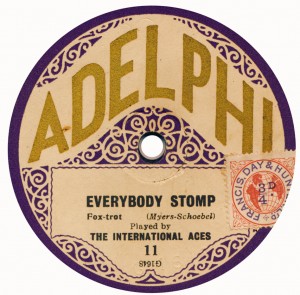
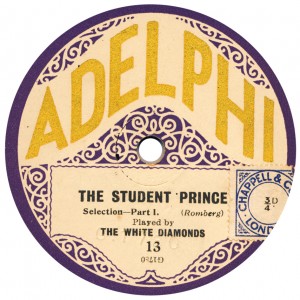
| Made for an unknown client, these discs were pressed by The Universal Music Co. at Hayes, Middlesex (often loosely known as ‘Vocalion’) from masters deriving from Aco, U.S. Vocalion, and perhaps other related sources. The only trouble is, they are so scarce as make their evaluation very difficult. The few known have numbers in single or low double figures; so probably only a first release was made, and nothing further happened? However, the G-series control numbers they bear can give us a clue to their date. Adelphi 13 bears G-1780, which is a very high number, and that series was abandoned in May 1926. This gives us a ball-park date for the appearance of this first (and only?) batch of Adelphis. (Adelphi 11 has G-1648 and G-1649, which fit well.) In addition, the ¾d copyright stamp indicates a retail price of half-a-crown, 2/6d, or 12.5p in current terms. ‘Mighty HMV’s’ popular series records were currently only 3/- (15p). Moreover, the above Adelphis are both acoustic recordings, while HMV’s had been made electrically for some time. | ||||
|
||||
 |
 |
|||
|
||||
 |
 |
|||
| |
||||
 |
 |
 |
 |
 |
|
||||
 |
 |
 |
||
|
||||
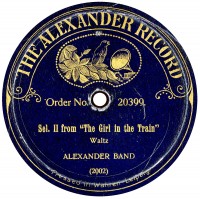
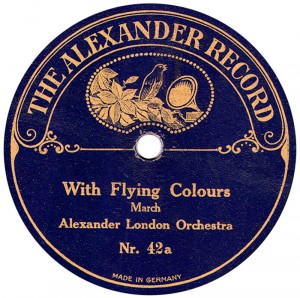
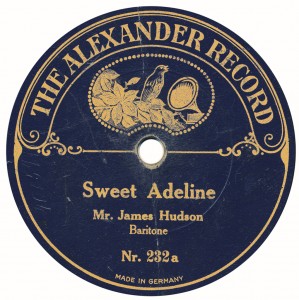
| A scarce label from pre-WWI. This one
actually states "Made in Germany" though the labelling is all
in English. It is thought to have been produced for the Alexander Record
Company of Birmingham, Chester, Coventry & Manchester. The catalogue series are the same as the Beka discs from whence the masters are all derived. They started at 1 or 100; the highest known being 478, the Beka issue of which was issued in late 1911. Alexander were not advertised in the trade journals of the time, leading to suspicion that it may have been a "tallyman" label, sold directly to customers, like John Bull records. |
||||
|
||||
 |
 |
 |
||
|
||||
 |
 |
 |
 |
 |
|
||||
 |
 |
 |
 |
 |
|
||||
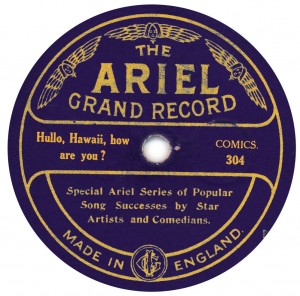
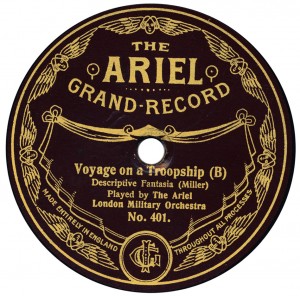
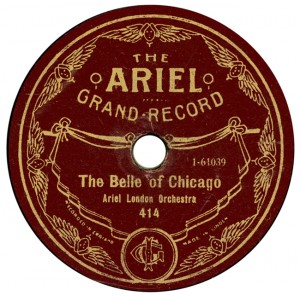
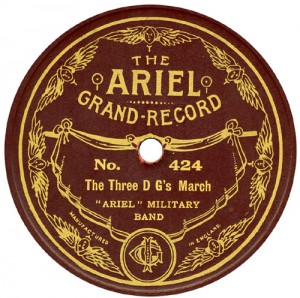
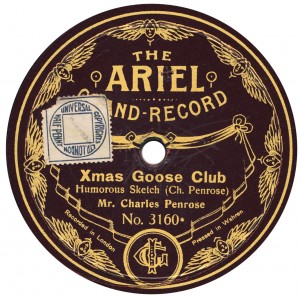
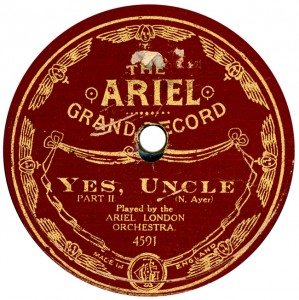
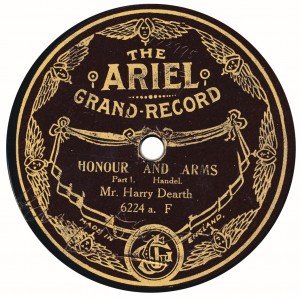
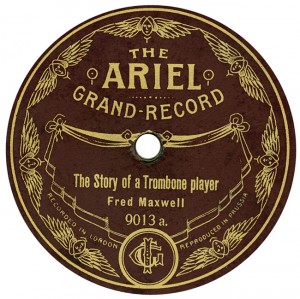
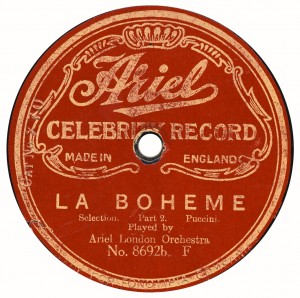
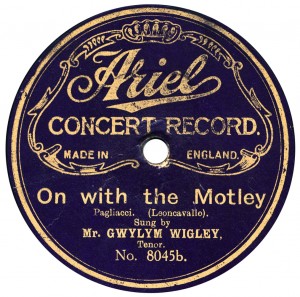
| The Ariel Grand Record (to give it the
correct title) was produced for Messrs J. G. Graves of Sheffield, England,
who sold them on a mail order basis. The label was available from 1910 until
1938, an amazing length of time for a store label. The masters came from
many sources over the years. The early ones from Beka, Favourite, Grammavox
& Jumbo; occasionally the label is found to be just a paste-over (I
have a John Bull with an Ariel label pasted over it), and examples have
been found as Winners with Ariel paste-overs, from the early 1920s. As far as dance music is concerned, in the early 1920s, Ariel was using Zonophone masters and some sides by "Jack Hylton's Jazz Band" may be found, along with others of a similar period, with a 2000 catalogue series, often anonymous. Generally, apart from this, almost all dance records are labelled as by "Ariel Dance Orchestra".In the later 1920s, was a 1000 series, again from Zonophone issued sides by the various Bert Firman groups (see picture 1.) Overlapping with this, Ariel used masters from Parlophone from about 1924 until 1938, using a 4000 series Catalogue number, later prefixed with a "Z". This included many American masters from OKeh records. Although Ariel has not been entirely catalogued, I have not found any using masters not already issued on Parlophone, though it is possible, especially as Parlophone did not use all the masters sent to them by OKeh.The label design changed little over the years as can be seen by the pictures here. There were also Classical series of "Ariel Celebrity Records" in a 10¾" size. The blue example shown here, is a rare "paste-over" Ariel of a different colour. This one was pasted over a Bell or Winner.Finally, the Ariel Concert is a 12" issue. |
||||
|
||||
 |
 |
 |
 |
 |
|
||||
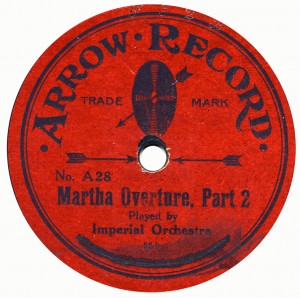
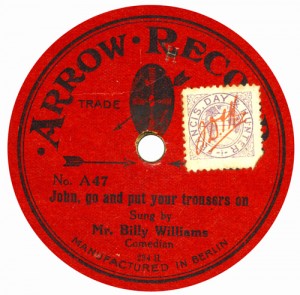
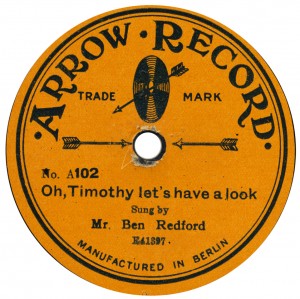
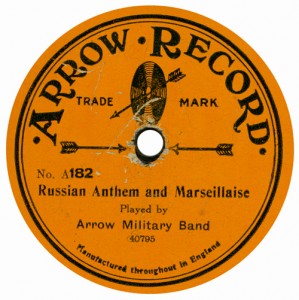
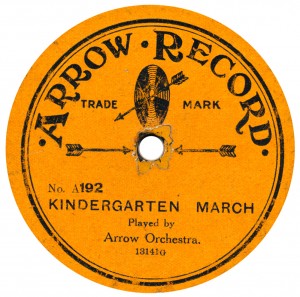
| An early British label pressed by the Carl Lindström group using Beka masters (often of an earlier vintage), Arrow existed from 1913 up to about 1916. It was a cheap line costing 1/1 or 1/- from The Scala Record company, introduced as a result of the Cinch and Phoenix records costing 1/1 produced by the Gramophone Company & Columbia, which themselves were a response to Lindström's Scala and Coliseum 1/6 records! The catalogue series was numbered A1 upwards to about A224. The label was either Red or Yellow. The Red labelled ones are earlier and were all manufactured in Germany. The yellow ones were made both in Germany and at Hertford, England, where Lindström had a record manufactory built in London in 1913.; some yellow labelled Arrows do not state a place of manufacture. | ||||
|
||||